In a world overflowing with social media noise and short-lived ad impressions, email remains one of the most powerful and cost-efficient channels for reaching decision-makers. For businesses that want consistent, scalable growth, email marketing for lead generation is not just relevant – it is essential.
But here’s the reality: not every email campaign generates quality leads. Sending generic blasts to a broad list and hoping for conversions is a strategy from a decade ago. Today’s buyers are more selective, more informed, and significantly harder to impress. This guide walks you through modern, data-backed email marketing strategies that actually fill your pipeline with prospects who are ready to engage.
Why Email Marketing Still Dominates Lead Generation in 2026
Before diving into tactics, let’s address the obvious question – with so many marketing channels available, why does email continue to outperform?
The answer lies in ownership and intent. Unlike social media platforms where algorithm changes can wipe out your organic reach overnight, your email list belongs to you. Every subscriber on your list has opted in, meaning they’ve already expressed interest in what you offer. That’s a level of permission and intent that paid ads simply cannot replicate.
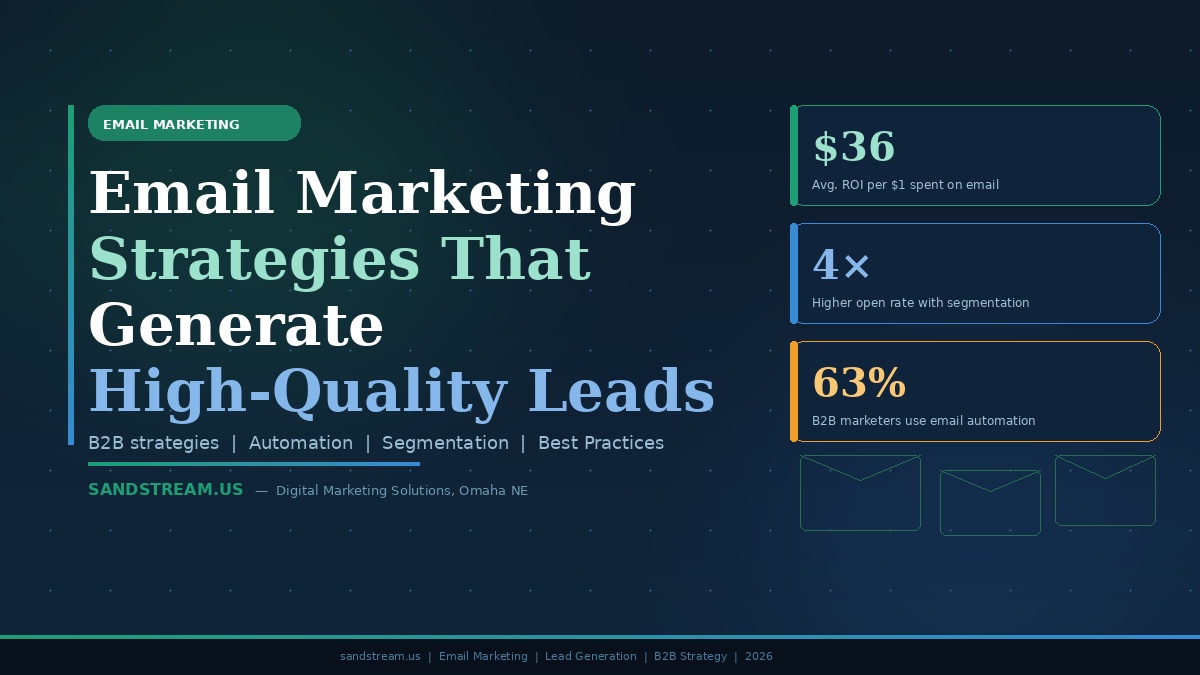
According to industry benchmarks, email marketing consistently delivers one of the highest returns on investment among all digital marketing tactics – often cited at $36 or more returned for every $1 spent. For B2B email marketing strategies specifically, email is frequently ranked as the top channel for pipeline generation and client nurturing.
The key, however, is how you use it.
Build a High-Intent List Before You Build a Campaign
The foundation of any successful email marketing for lead generation effort is your subscriber list. A smaller, highly targeted list will always outperform a massive, disengaged one.
Here’s how to build one with purpose:
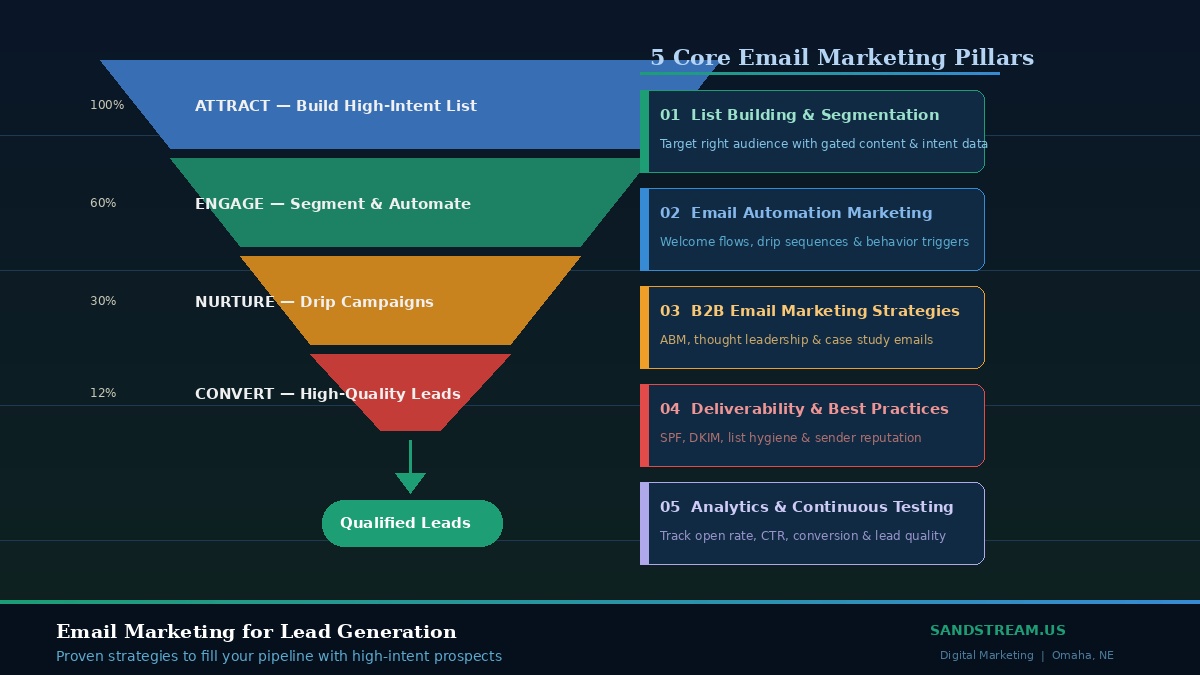
Use gated content strategically. Offer real value – a detailed industry report, a free audit, an actionable checklist, or an exclusive webinar – in exchange for an email address. The more specific and relevant your lead magnet is to your target audience’s problems, the higher the quality of leads you’ll attract.
Optimize your opt-in forms. Placement matters. Embed sign-up forms in high-traffic blog posts, your homepage hero section, and exit-intent popups. Keep your copy concise and benefit-driven. Instead of “Subscribe to our newsletter,” try “Get weekly email marketing tips that drive real revenue.”
Leverage intent data. If you’re running B2B email marketing strategies, integrate your list-building with your CRM and web analytics. Capture leads who’ve visited your pricing page, downloaded multiple resources, or engaged with your product demos — these are your warmest prospects.
Segment Your List for Maximum Relevance
One of the most impactful email marketing best practices is audience segmentation. Sending the same message to everyone on your list is a fast track to high unsubscribe rates and mediocre conversions.
Segmentation means dividing your list into smaller groups based on shared characteristics so you can deliver messages that feel tailor-made. Common and highly effective segmentation criteria include:
- Industry or vertical: particularly important in B2B, where pain points differ wildly between, say, a healthcare company and a SaaS startup
- Stage in the buyer journey: a cold prospect needs educational content, while someone who has already requested a demo needs a push toward a decision
- Past engagement behavior: segment users who clicked a specific link, opened a previous campaign, or visited a product page
- Company size or revenue: for B2B marketers, this helps personalize messaging around scale and budget
When your subscribers receive emails that speak directly to their role, industry, and current challenge, open rates climb, click-throughs improve, and unsubscribes drop. Segmentation is not optional – it’s foundational.
Master the Art of Subject Lines and Preheader Text
You can write the most compelling email in history, but it means nothing if no one opens it. Your subject line and preheader text are your first – and sometimes only – impression.
Here are the principles that consistently drive higher open rates:
Create curiosity without being clickbait. Phrases that tease a benefit or create a knowledge gap perform exceptionally well. Example: “The B2B email mistake that’s costing you 40% of your leads” is far more compelling than “Email Marketing Tips.”
Personalize beyond the first name. Yes, inserting a contact’s name helps. But referencing their industry, company type, or a specific challenge they face takes personalization to a level that feels genuinely relevant. Tools in modern email automation marketing platforms make this scalable.
Keep it tight and test relentlessly. Subject lines between 40–50 characters tend to perform best on mobile. A/B test subject line variations – different tones, structures, length, and emotional triggers – and let data drive your decisions over time.
Don’t ignore preheader text. The 90–140 characters that appear after your subject line in the inbox preview are prime real estate. Use them to add context or build on the subject line’s hook, not to repeat it.
Use Email Automation Marketing to Nurture Leads at Scale
This is where modern email strategy truly separates the average from the exceptional. Email automation marketing allows you to deliver the right message, to the right person, at precisely the right moment – without requiring manual effort for every send.
Here’s a breakdown of automation workflows that generate the highest-quality leads:
Welcome Sequence: When someone subscribes or downloads a lead magnet, your welcome sequence sets the tone. Don’t lead with a sales pitch. Instead, deliver on the promise that earned their subscription, introduce your brand’s unique perspective, and guide them toward their next logical step.
Lead Nurture Drip Campaigns: These are multi-email sequences designed to educate a prospect and build trust over time. A well-structured B2B drip campaign might span 4–8 emails over 2–3 weeks, each addressing a different pain point and progressively introducing your solution as the answer.
Behavior-Triggered Emails: These are triggered by specific actions – a contact clicking on your pricing page, abandoning a form, or re-engaging after a period of inactivity. Because they’re sent based on real user intent, behavior-triggered emails consistently outperform broadcast campaigns in both open and conversion rates.
Re-Engagement Campaigns: Not every subscriber stays engaged forever. A strategic re-engagement sequence can win back dormant contacts before they disengage permanently. Offer something compelling – a fresh resource, an exclusive offer, or a direct question asking if they still want to hear from you.
Craft Emails That Convert, Not Just Impress
Design matters, but conversion is the goal. Too many brands create visually stunning emails that fail to drive action. Here’s how to write and structure emails that convert:
Lead with value, not features. Your reader wants to know what’s in it for them. Start every email with the most compelling benefit, not a product description or company update.
Write conversationally. Especially in B2B, the most effective emails often feel like a message from a trusted colleague, not a corporate broadcast. Use “you” language, ask direct questions, and keep paragraphs short.
One email, one CTA. Every email should have a single, clear call-to-action. Multiple CTAs split attention and reduce the likelihood that anyone acts at all. Whether your goal is to book a call, download a guide, or watch a demo – commit to one outcome per email.
Mobile-first design. Over 60% of emails are now opened on mobile devices. If your email isn’t fully responsive and easy to read on a 5-inch screen, you’re losing leads before they even read your message.
B2B Email Marketing Strategies That Accelerate Pipeline Growth
Business-to-business email marketing operates on a different timeline than consumer campaigns. Sales cycles are longer, multiple stakeholders are involved, and trust must be built before any commitment is made. Here’s what works specifically for B2B:
Account-Based Marketing (ABM) via Email: Rather than casting a wide net, ABM focuses your email efforts on a defined list of high-value target accounts. You craft personalized messaging specifically for key decision-makers within those organizations. The result is higher engagement and faster movement through the funnel from companies with the greatest revenue potential.
Thought Leadership Content: B2B buyers respect expertise. Sending curated insights, original research, or contrarian perspectives on industry trends positions your brand as a trusted authority rather than just another vendor. Over time, this kind of content builds the credibility required to earn a conversation.
Case Study and Social Proof Emails: Nothing moves a B2B prospect closer to a decision faster than proof. Structure a dedicated email around a customer success story — ideally from an industry similar to your prospect’s — that clearly articulates the challenge, the approach, and the measurable outcome.
Event and Webinar Invitations: Hosting or participating in industry events is an excellent lead generation tool, and email is the ideal channel to drive registrations. Segment these invitations by interest and seniority to maximize attendance from the right people.
Measure What Matters: Key Email Marketing Metrics
Effective email marketing strategies are never built on assumptions — they’re refined through consistent measurement. Here are the metrics that matter most for lead generation:
- Open Rate: Reflects the health of your subject lines and sender reputation. Industry averages vary, but anything above 25% is generally strong for B2B.
- Click-Through Rate (CTR): Measures how compelling your content and CTA are. A high open rate with a low CTR signals that your body copy or CTA needs optimization.
- Conversion Rate: The percentage of recipients who complete the desired action — downloading, booking, purchasing. This is your true north metric.
- Lead Quality Score: Not all leads are equal. Track how many email-generated leads become qualified opportunities and eventually customers. This tells you whether you’re attracting the right audience.
- Unsubscribe Rate: A rising unsubscribe rate is an early warning signal. It means something in your content, frequency, or targeting is misaligned with subscriber expectations.
Review these metrics after every campaign and implement a consistent A/B testing cadence. Small, data-driven improvements compound into significant gains over time.
Deliverability: The Silent Killer of Email Campaigns
You can have the best content, the most refined segmentation, and flawless automation workflows – but if your emails aren’t landing in the inbox, none of it matters. Email deliverability is one of the most overlooked email marketing best practices, yet it directly determines campaign success.
Key deliverability factors to manage:
Authenticate your sending domain. Ensure your domain is properly configured with SPF, DKIM, and DMARC records. These protocols signal to inbox providers that your emails are legitimate and authorized.
Maintain a clean list. Regularly remove hard bounces, inactive subscribers, and invalid addresses. Sending to a dirty list damages your sender reputation over time and can land your campaigns in spam folders.
Warm up new IPs gradually. If you’re migrating to a new email service provider or launching a new sending domain, start with low volumes and ramp up gradually. Jumping straight to high-volume sends raises red flags with spam filters.
Monitor your sender reputation. Use tools like Google Postmaster Tools and third-party reputation monitors to keep tabs on your domain and IP health. Address issues proactively before they derail a campaign.
Align Email with Your Broader Marketing Ecosystem
The most effective email marketing strategies don’t operate in isolation. They function as a central thread connecting your broader marketing ecosystem.
- Sync with your CRM: Ensure lead data from email campaigns flows directly into your CRM so your sales team has full visibility into prospect engagement history before they reach out.
- Coordinate with paid advertising: Use email engagement data to build retargeting audiences. Contacts who opened your last three emails but haven’t converted are high-intent candidates for a targeted paid social push.
- Amplify with content marketing: Promote your best blog posts, videos, and resources through email. Drive traffic back to your website, increasing the touchpoints that move leads forward.
- Support sales outreach: In B2B, email marketing and direct sales outreach should be complementary. Marketing emails warm prospects up and build familiarity so that when a salesperson reaches out, the conversation starts from a position of trust rather than cold contact.
Final Thoughts: Build an Email Engine, Not Just a Campaign Calendar
The businesses generating the highest-quality leads through email aren’t just sending good emails -they’ve built systems. They have intentional list-building strategies, thoughtful segmentation, automated nurture sequences, and a culture of continuous testing and improvement.
Whether you’re just beginning to invest in email marketing for lead generation or looking to elevate a program that’s plateaued, the strategies outlined in this guide give you a clear, actionable roadmap. Start with your audience, build for relevance, automate for scale, and measure relentlessly.
At SandStream, we help businesses across industries design and execute email marketing programs that generate measurable pipeline growth. From strategy and platform selection to creative execution and data integration, our team brings the expertise to make your email program a true revenue driver.
Ready to transform your email marketing into a lead generation machine? Connect with the SandStream team today.
Frequently Asked Questions