
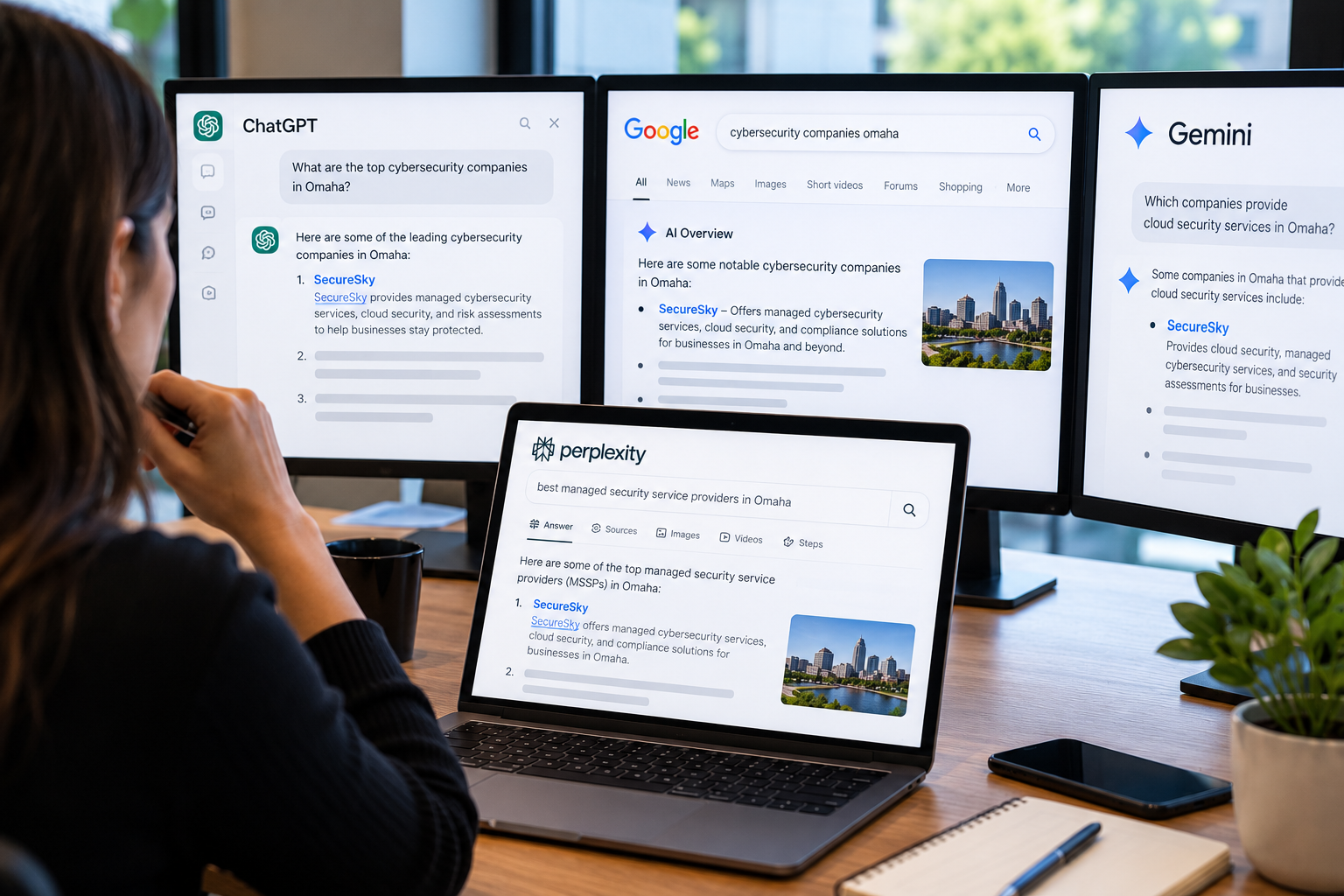
When someone asks ChatGPT, Gemini, Claude, or Perplexity to recommend a digital marketing agency, does your business appear in the answer? Does the AI cite your website, recommend a competitor, or provide information about your services from another source?
If you cannot answer these questions, you may have a gap in your digital marketing strategy.
An AI search visibility audit helps you determine whether your brand appears in AI-generated answers, which pages are cited, how competitors compare, and what you can improve to increase your chances of being discovered.
Traditional SEO helps businesses compete for visibility in search engine results. AI search optimization also considers how your brand and content appear in generated answers, conversational recommendations, and AI-powered search experiences.
For businesses investing in SEO, content marketing, and lead generation, measuring both types of visibility provides a more complete understanding of how potential customers discover their services.
This guide explains how to audit your AI search presence, measure brand mentions and website citations, identify competitor gaps, and turn your findings into a practical optimization plan.
What Is an AI Search Visibility Audit?
An AI search visibility audit is the process of testing how often, where, and how accurately your business appears in AI-generated answers across relevant platforms and customer questions.
The audit examines whether AI systems mention your brand, cite your website, describe your services correctly, and include your business in answers related to your industry.
For example, a digital marketing agency could test this question:
“Which digital marketing agencies help businesses improve visibility in Google AI Overviews and ChatGPT?”
The agency would then check whether its name appears, whether its website is cited, which competitors are recommended, and whether the answer accurately represents its services.
A useful audit measures five separate signals:
- AI brand visibility: How often your business appears in relevant AI-generated answers.
- Website citations: How often AI responses link to or identify your website as a source.
- Brand accuracy: Whether AI-generated descriptions correctly explain your services and expertise.
- Competitive visibility: Which competing businesses appear for the same questions.
- AI referral traffic: Whether visitors arrive from AI platforms and take meaningful actions on your website.
These measurements answer different questions. A brand mention does not automatically mean your website was cited, and a citation does not guarantee a website visit or conversion.
Why Is AI Search Visibility Important for SEO and Lead Generation?
AI search visibility matters because potential customers can use conversational AI tools to research services, compare providers, and identify businesses before visiting individual websites.
Consider a business owner looking for help with organic traffic and AI search optimization. The owner asks an AI assistant to explain how GEO works and recommend agencies that offer the service.
If your business appears in the answer with a relevant website citation, the user has an opportunity to discover your services. If competing agencies appear instead, those businesses may receive the attention.
An AI search visibility audit helps you identify these opportunities by answering four practical questions:
- Does your brand appear when potential customers ask relevant questions?
- Which pages or external sources support your brand’s visibility?
- Which competitors appear for questions your business should be relevant to?
- What content or website improvements could make your business more useful and discoverable?
AI visibility should complement, not replace, traditional SEO measurement. Organic rankings, qualified traffic, engagement, inquiries, and conversions remain important indicators of marketing performance.
How to Run an AI Search Visibility Audit in 6 Steps
Step 1: Identify the Customer Questions That Matter to Your Business
Start with questions that reflect what your potential customers want to know before choosing a service provider.
Do not limit your audit to searches containing your brand name. People who have never heard of your company are more likely to use general questions about their problems, available solutions, and service providers.
For Sandstream, relevant test questions could include:
Informational questions
- What is an AI search visibility audit?
- How does generative engine optimization improve brand discovery?
- How can a business measure its visibility in Google AI Overviews?
- How do AI search results differ from traditional Google results?
Commercial questions
- Which AI search visibility tools help monitor brand mentions?
- How can a business improve its visibility in ChatGPT answers?
- What should a company include in an AI search optimization strategy?
- How can a digital marketing agency measure AI search performance?
Branded questions
- What AI optimization services does Sandstream offer?
- How can Sandstream help businesses improve their AI search presence?
- What digital marketing services does Sandstream provide?
Use questions that match your actual services and customer needs. Do not describe a service as available unless your business genuinely offers it.
For an initial audit, select 20–30 questions and group them by topic, intent, and relevance to your business.
Step 2: Test Your Brand in ChatGPT, Gemini, Claude, Perplexity, and Google AI Overviews
Enter the same questions into the AI platforms you want to monitor. Where a feature or browsing capability is unavailable, record that limitation instead of treating the test as a failed brand mention.
For each response, record the following:
| Audit field | What to check |
|---|---|
| Brand mention | Does the response name your business? |
| Website citation | Does it cite or link to your website? |
| Relevant service | Does the response connect your brand to the right service? |
| Competitors | Which competing brands appear? |
| Source quality | Which websites or sources support the answer? |
| Accuracy | Is the information about your business correct? |
| Test date | When was the response collected? |
Repeat important queries over time. AI-generated answers can vary with prompt wording, available sources, location, platform features, and other contextual factors.
AEO tip: Use natural-language questions that reflect how people actually ask AI assistants for help. Include direct questions, comparisons, and service-specific queries rather than testing only short keywords.
GEO tip: Record not just whether your brand appears, but also which sources are cited and what information supports the answer. This helps you identify opportunities to make your own content more relevant, informative, and trustworthy.
Step 3: Measure Brand Mentions and Website Citations Separately
Brand visibility in AI results has more than one dimension. Your company might be mentioned without a link, or your website might be cited without your brand receiving a prominent recommendation.
For example:
- Mention without citation: An AI assistant names your company but does not link to your website.
- Citation without a prominent recommendation: An AI response links to one of your educational articles as a source.
- Mention with citation: The response names your business and links to a relevant page.
- No visibility: Your brand and website are absent from the tested answer.
These outcomes should be tracked separately because they suggest different opportunities.
If your brand is absent from relevant questions, investigate your topic coverage, business information, and presence across credible sources.
If your brand is mentioned but your website is not cited, review whether your pages provide useful evidence, clear explanations, and relevant answers to the questions being tested.
If your website is cited but the brand description is inaccurate, check your service pages and other sources that describe your business.
How to calculate your AI search visibility rate
Use a consistent set of tested responses to calculate a basic mention rate:
AI brand mention rate = Responses mentioning your brand ÷ Total valid responses tested × 100
For example, if your brand appears in 8 of 25 valid responses, its mention rate for that audit is 32%.
You can calculate website citation rate using the same method, counting only responses that cite your website.
These are internal tracking metrics, not official scores used by ChatGPT, Google, or other AI platforms. They describe your selected prompts and test conditions, not your total visibility across all AI searches.
Step 4: Compare Your Brand With Competitors in AI Results
Competitor analysis helps you discover why another business appears in AI answers when yours does not.
Choose three to five direct competitors and test the same prompts across the same platforms. Record which brands appear, their descriptions, and the sources associated with their mentions.
Look for patterns such as:
- A competitor repeatedly appearing in answers about a service you provide.
- A competitor’s educational article being cited for a question your content also addresses.
- Your business appearing for branded questions but not for broader service-related questions.
- Industry publications, directories, or expert resources being cited more frequently than company websites.
For example, suppose competing agencies are mentioned when users ask how to improve visibility in AI search results. Review their relevant content to identify whether it provides clearer explanations, practical examples, original research, or stronger evidence of expertise.
Use those findings to develop more useful content rather than copying competitor wording.
The goal is not simply to appear more often than another business. It is to become a relevant, credible source for the questions your potential customers actually ask.
Step 5: Audit Your Website for AEO and GEO Opportunities
Once you have identified visibility gaps, review your website to determine whether its content and technical setup support discovery.
AEO: Make your content answer questions directly
Answer Engine Optimization focuses on helping people find clear, useful answers to their questions across search and answer-based experiences.
Review your content for these opportunities:
- Add concise definitions near the beginning of relevant articles.
- Use question-based headings that match customer search intent.
- Provide clear, direct answers before expanding into supporting details.
- Organize processes into numbered steps.
- Include relevant FAQs that address genuine customer questions.
- Support factual claims with credible sources and evidence.
For example, a section titled “How Do You Measure AI Search Visibility?” should answer the question immediately before explaining the metrics, tools, and limitations.
This structure improves usability and makes important information easier to identify. It does not guarantee a featured snippet or inclusion in an AI-generated response.
GEO: Strengthen the information AI systems can discover and evaluate
Generative Engine Optimization focuses on improving the relevance, clarity, and credibility of content for AI-powered search and answer experiences.
Review these areas:
Original, useful content: Explain your methods, share genuine experience, and provide practical examples rather than publishing generic summaries of existing information.
Clear brand information: Make your company name, services, expertise, and contact information easy to understand.
Relevant third-party references: Build genuine industry relationships and earn relevant mentions through original research, expert contributions, and useful resources.
Accurate supporting information: Keep service pages, company descriptions, and important business details consistent with what you actually offer.
Logical internal links: Connect related educational articles and service pages so readers can move naturally from learning about a problem to finding a solution.
Accessible technical content: Check crawlability, indexability, canonical tags, redirects, and other technical issues that could prevent search systems from accessing important pages.
Appropriate structured data: Use valid schema markup when it accurately describes visible content. Structured data can clarify meaning, but it does not guarantee AI citations or recommendations.
For Sandstream, the goal is to connect educational content about AI search visibility with relevant AI optimization and digital marketing services, giving readers a natural next step when they need professional help.
Step 6: Track AI Referral Traffic and Qualified Leads
An AI visibility audit should not stop at brand mentions. It should also investigate whether AI discovery contributes to website visits and business outcomes.
Use Google Analytics 4 or another analytics platform to review available referral traffic from AI services. Examine source information, landing pages, engagement, and conversions where attribution is available.
Track these metrics alongside your audit:
- AI referral sessions.
- Engaged sessions from identifiable AI referrals.
- Visits to relevant service pages.
- Contact form submissions and qualified inquiries.
- Conversions attributable to AI referral traffic.
- Organic search performance for related topics.
Attribution has limitations. Some AI-assisted visits may appear as direct traffic or may not be identifiable as AI referrals. Google Search Console also does not provide a universal, complete report of brand mentions and citations across every AI platform.
Use referral data as one source of evidence, not as a complete measure of AI visibility.
For a more reliable comparison, record your baseline before making changes and review performance over time.
Which AI Search Visibility Tools Should You Use?
The right tool depends on whether you want to inspect individual answers, measure website traffic, or monitor brand visibility at scale.
| Tool or method | Best use |
|---|---|
| Manual testing in ChatGPT, Gemini, Claude, and Perplexity | Checking brand mentions, citations, and answer accuracy |
| Google Search with AI Overviews, where available | Reviewing your brand’s appearance in AI-powered search answers |
| Google Search Console | Monitoring available Google search performance data |
| Google Analytics 4 | Measuring attributable website traffic and conversions |
| Dedicated AI visibility monitoring platforms | Tracking prompts, citations, competitors, and visibility trends where supported |
Start with manual testing if you have a limited budget. Consider dedicated monitoring software when you need to test many prompts, compare competitors regularly, or report visibility changes to stakeholders.
Before choosing a paid platform, check which AI services it covers, how it defines visibility, whether it distinguishes mentions from citations, and how frequently its data is refreshed.
Do not compare scores from different providers as though they were measured using the same methodology.
How Often Should You Run an AI Search Visibility Audit?
For many businesses, a monthly audit is a practical starting point, followed by a deeper quarterly review.
A monthly review can help identify changes in brand mentions, citations, competitor visibility, and relevant referral traffic. A quarterly review can evaluate broader content gaps, technical issues, and the impact of optimization work.
Run additional checks after significant changes to important pages, a major content campaign, or a change in your services.
To make comparisons useful, keep your core prompt set consistent, record the platforms tested, and document the changes you make.
Do not change your entire content strategy because of one missing mention or an isolated AI response.
Improve Your AI Search Presence With a Measurable Strategy
Your business may already have useful content and established organic search visibility, but that does not automatically mean it will appear in AI-generated answers.
An AI search visibility audit helps you understand where your brand stands by testing relevant customer questions, separating mentions from citations, comparing competitors, and reviewing your website’s content and technical accessibility.
The next step is to turn the findings into a focused action plan: answer customer questions more clearly, strengthen important service pages, publish original expertise, correct inaccurate business information, and track measurable results over time.
For businesses that want to improve their visibility across traditional search and AI-powered discovery, Sandstream’s AI optimization and digital marketing services can support a broader strategy for reaching relevant audiences and generating qualified opportunities.
Visit Sandstream to learn more about its services and identify the next steps for your digital marketing strategy.