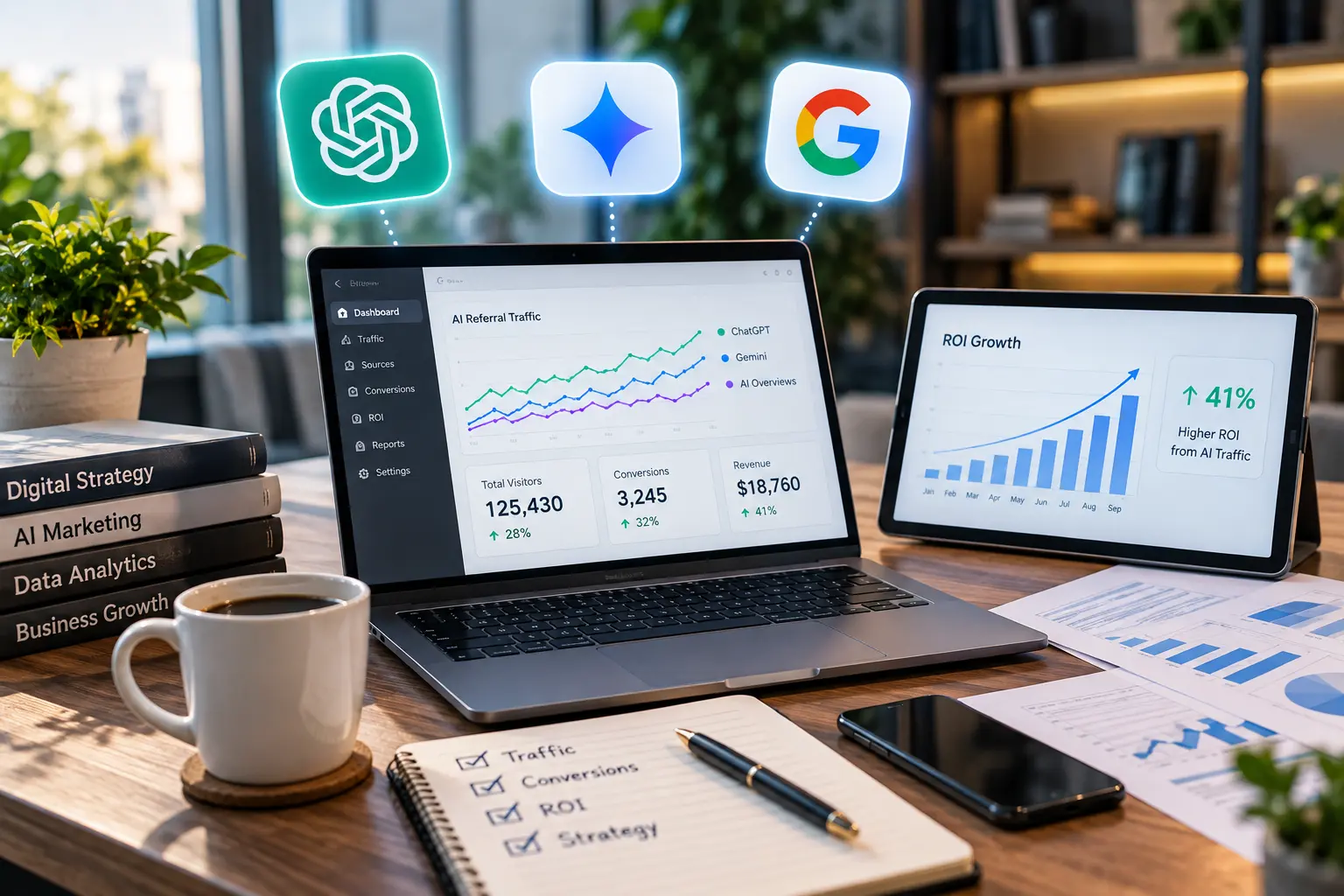
Search has changed. People aren’t just typing keywords into a search bar anymore — they’re asking full questions to ChatGPT, Google AI Mode, Gemini, and Perplexity, and expecting a direct answer, not a list of ten blue links. If your business isn’t showing up in those answers, you’re invisible to a growing share of your potential customers.
This is where Answer Engine Optimization (AEO) comes in. AEO is the practice of structuring your content so AI-powered search tools can understand it, trust it, and cite it as the answer. It works alongside traditional SEO, but it plays by a different set of rules.
This guide breaks down what AEO actually means, how it differs from traditional SEO, and the exact steps you can take to get your business featured in AI-generated answers across ChatGPT, Gemini, and Google AI Mode.
What Is Answer Engine Optimization (AEO)?
Answer Engine Optimization is the process of optimizing your website content so AI search tools can extract, understand, and present it as a direct answer to a user’s question. Instead of optimizing purely to rank on a search results page, AEO optimizes your content to become the answer itself.
Traditional SEO asks: “How do I rank #1 on Google for this keyword?”
AEO asks: “How do I become the source an AI model quotes when someone asks this question?”
The two goals overlap heavily — clean structure, authority, and clarity help both — but AEO puts more weight on how easily a machine can lift a clear, self-contained answer out of your page.
Why AEO Matters Right Now
AI Search Optimization isn’t a future trend — it’s already reshaping how people find businesses, compare products, and make decisions. Chat-based tools and AI Overviews are increasingly the first stop for research-heavy or question-based searches (“best CRM for small teams,” “how much does foundation repair cost,” “top vehicle wrap companies near me”).
When your content is structured for AEO, you get three real advantages:
- Visibility where traditional SEO can’t reach. Your brand can appear directly inside an AI-generated answer, even if you’re not the #1 organic result.
- Higher-intent traffic. Users who click through from an AI answer already trust the source — that trust often converts into a lead faster than a cold organic visitor.
- A competitive head start. Most businesses still aren’t optimizing for AI search. Doing it now puts you ahead before it becomes standard practice.
AEO vs. SEO vs. GEO: What’s the Difference?
These terms get used interchangeably, but they aren’t quite the same thing.
SEO (Search Engine Optimization) focuses on ranking in traditional search engine results pages — think blue links, meta tags, backlinks, and keyword targeting for Google’s classic algorithm.
AEO (Answer Engine Optimization) focuses on getting your content selected and surfaced as a direct answer inside AI tools like ChatGPT, Gemini, and voice assistants.
GEO (Generative Engine Optimization) is closely related to AEO and focuses specifically on how your content performs inside generative AI outputs — including AI Overviews, chat responses, and summarized answers — factoring in how these models decide which sources to cite and quote.
In practice, the three overlap so much that most businesses should treat them as one connected strategy: build content that’s crawlable and authoritative (SEO), structured for direct extraction (AEO), and trustworthy enough for a generative model to cite by name (GEO).
How AI Search Engines Actually Choose an Answer
Before optimizing anything, it helps to understand what these tools are looking for.
AI search tools generally favor content that is:
- Direct and self-contained — the answer doesn’t require the reader to click through multiple pages to understand it.
- Structured clearly — headers, lists, and short paragraphs are easier for a model to parse and extract than dense blocks of text.
- Backed by clear authority signals — author expertise, business credentials, and consistent information across the web.
- Fresh and accurate — outdated or conflicting information gets filtered out in favor of more current sources.
- Marked up for machines — structured data (schema markup) helps AI tools understand exactly what a page is about, not just what it says.
Every AEO strategy below is built around these five factors.
ChatGPT SEO: How to Get Cited by ChatGPT
ChatGPT SEO focuses on how OpenAI’s models source and reference information, particularly when browsing is enabled or when ChatGPT pulls from indexed web content.
What helps:
- Write in a natural question-and-answer format. If people commonly ask, “How much does X cost?” or “What’s the best way to do Y?” — answer that exact question in a clear sentence near the top of the relevant section.
- Keep answers concise before expanding. Give the direct answer in 2–3 sentences, then elaborate below it. This “answer first, explain after” format is exactly what gets pulled into AI responses.
- Build topical authority. ChatGPT tends to favor sources that consistently cover a subject in depth, not single one-off articles.
- Make sure your business information (name, services, location, pricing ranges) is consistent across your website, Google Business Profile, and third-party directories. Conflicting information anywhere online reduces trust signals.
Google AI Mode: Optimizing for Google’s AI-Powered Search
Google AI Mode blends traditional ranking signals with generative summarization. This means classic SEO fundamentals still matter — but they’re no longer enough on their own.
What helps:
- Strong E-E-A-T signals (Experience, Expertise, Authoritativeness, Trustworthiness). Author bios, credentials, and clear business ownership information all support this.
- Structured data (schema markup) — FAQ schema, HowTo schema, and Organization schema help Google AI Mode understand and summarize your content accurately.
- Featured-snippet-style formatting. Content that already performs well in Google’s “People Also Ask” and featured snippets tends to translate directly into AI Mode visibility, because the underlying formatting principles are the same.
- Page experience fundamentals. Fast load times, mobile usability, and clean navigation remain part of Google’s evaluation, even for AI-generated results.
Gemini SEO: Standing Out in Google’s Gemini Model
Gemini SEO overlaps with Google AI Mode since both are Google products, but Gemini is also accessed as a standalone assistant and integrated across Google Workspace tools, which changes how content gets surfaced.
What helps:
- Prioritize accuracy and specificity. Gemini tends to favor content that answers a question precisely rather than broadly — vague, marketing-heavy copy performs worse than clear, factual explanations.
- Use structured formatting (numbered steps, comparison tables, bullet summaries) for any process- or comparison-based content.
- Keep content updated. Gemini, like other AI models, deprioritizes outdated statistics, pricing, or claims — revisit and refresh key pages regularly.
- Reinforce topical relevance across your site. A single optimized page helps, but a cluster of related, interlinked pages on the same topic builds stronger authority signals.
A Practical AEO Checklist for Your Website
Here’s a starting framework you can apply to any page you want AI search tools to notice:
- Lead with the answer. Put a clear, direct answer to the core question in the first 1–2 sentences of the relevant section.
- Use question-based headers. Structure H2s and H3s as real questions people search for (“How much does vehicle wrap installation cost?”).
- Add FAQ sections. These map almost directly to how AI tools extract and cite answers.
- Implement schema markup. FAQ, HowTo, Article, and Organization schema all help AI models understand page context.
- Keep paragraphs short. Long, unbroken paragraphs are harder for models to extract cleanly.
- Cite real data and sources. Avoid vague claims; specific, sourced information is more likely to be trusted and reused.
- Maintain consistency across the web. Your name, services, and key facts should match across your website, directories, and social profiles.
- Update content regularly. Stale pages lose ground to fresher, more accurate competitors.
Common AEO Mistakes to Avoid
- Burying the answer. If your direct answer is three paragraphs deep, AI tools may skip your page entirely in favor of a competitor who answers immediately.
- Keyword stuffing over clarity. AI models prioritize natural, accurate language over repeated keyword phrases.
- Ignoring structured data. Skipping schema markup makes it significantly harder for AI tools to understand your content’s context.
- Treating AEO as separate from SEO. The strongest results come from strategies that support both traditional rankings and AI visibility together.
Final Thoughts
AI Search Optimization isn’t a niche tactic anymore — it’s becoming a core part of how businesses get discovered. Answer Engine Optimization, ChatGPT SEO, Google AI Mode readiness, and Gemini SEO all come back to the same core principle: give AI tools a clear, well-structured, trustworthy answer, and they’ll surface it.
The businesses that adapt their content strategy now — before AEO becomes standard practice — will have a real head start in AI-driven search visibility, traffic, and leads.