Google regularly updates its search ranking systems to improve the quality and relevance of search results. These changes can influence how websites appear in Google Search, making it important for businesses to monitor their SEO performance and maintain a strong online presence.
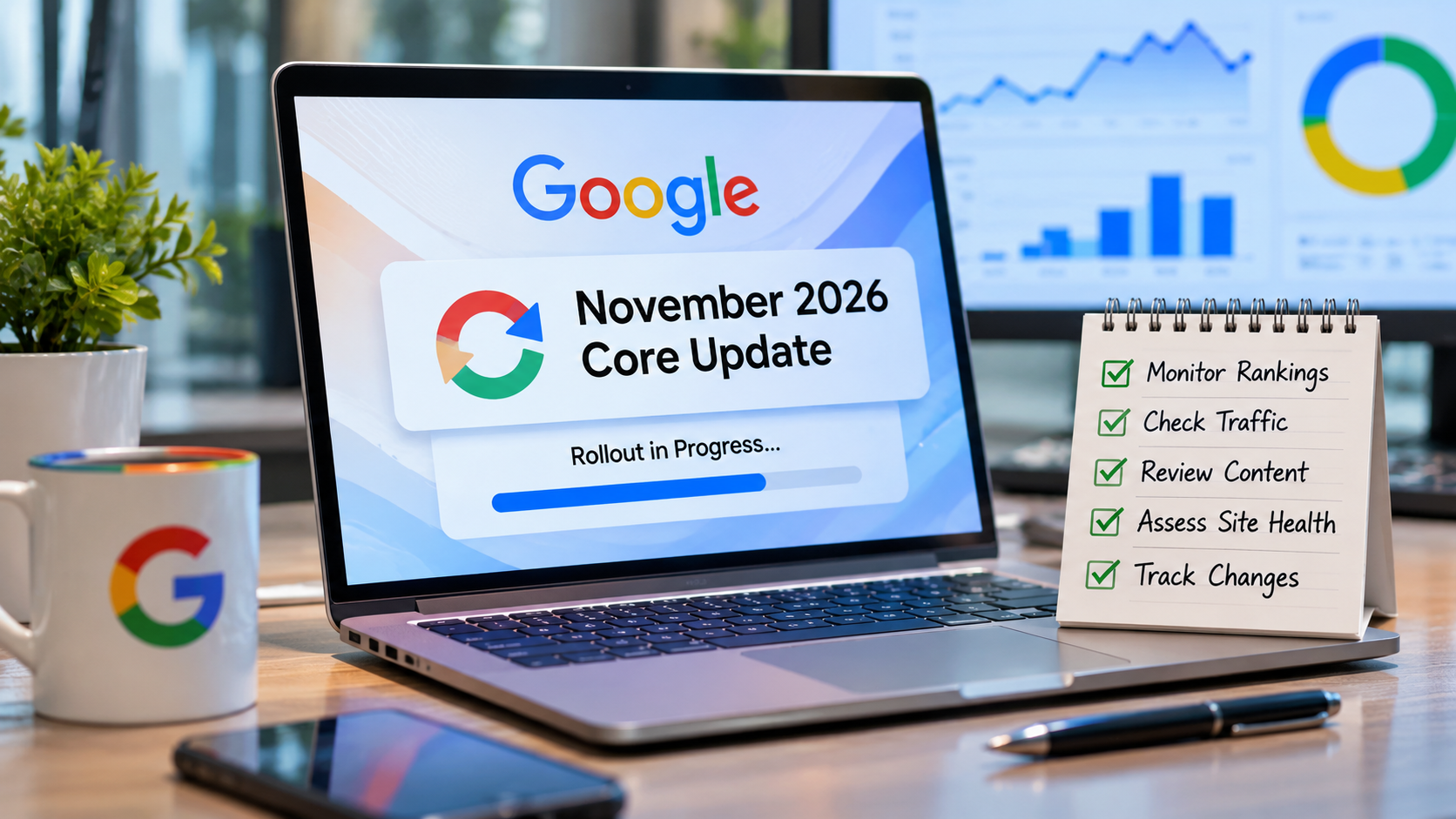
Google released the November 2026 core update on November 10, 2026. According to Google’s Search Status Dashboard, the update applies globally and across all languages, with a rollout period of up to two weeks. This means website owners may notice changes in search performance while Google completes the rollout.
But what should businesses monitor during this period? Should they change their website content, update existing pages, or wait until the rollout finishes?
The best approach is to monitor performance carefully, identify meaningful changes, and avoid making unnecessary SEO adjustments based on short-term ranking movements.
In this guide, we explain what the Google November 2026 core update means for website owners, which SEO metrics to track, and how businesses can prepare their websites for potential search ranking changes.
What Is the Google November 2026 Core Update?
The Google November 2026 core update is a broad update to Google’s core ranking systems designed to improve how its search engine evaluates and ranks content.
Unlike updates that target a specific technical issue or spam practice, core updates involve broader changes to Google’s ranking systems. These changes can affect how different pages perform in search results.
Google announced the November 2026 core update on November 10, 2026, and stated that the rollout could take up to two weeks.
Here are the key details:
- Update: November 2026 Core Update
- Release date: November 10, 2026
- Search coverage: Global
- Languages: All languages
- Expected rollout: Up to two weeks
- Affected area: Google Search rankings
Website owners should understand that ranking changes during the rollout do not automatically indicate a permanent SEO problem. Search positions can move as Google’s systems continue processing the update.
For this reason, monitoring actual website performance is more useful than reacting to every ranking fluctuation.
Why Should Website Owners Monitor the November 2026 Core Update?
A Google core update can influence organic search performance, including keyword positions, impressions, clicks, and website traffic.
For businesses that depend on Google Search for leads and customer inquiries, even changes in important landing page visibility deserve attention.
However, not every ranking movement requires immediate action.
Monitoring helps website owners understand whether changes are temporary, whether specific pages are experiencing performance differences, and whether their organic search visibility is changing.
Here are five important reasons to monitor the update.
1. Identify Google Ranking Fluctuations Early
Google ranking fluctuations can happen during a core update rollout. Some pages may gain visibility, while others may experience changes in their search positions.
Monitoring keyword performance helps businesses identify which pages and search queries are changing.
For example, an Omaha-based digital marketing agency may track keywords such as:
- Digital marketing agency Omaha
- SEO services Omaha
- Website development Omaha
- Local SEO services
- PPC management services
If several important keywords begin showing different positions, website owners can investigate whether the changes are limited to specific pages or affect multiple sections of their websites.
Avoid making major content changes based on one or two days of ranking data. Look for consistent patterns before deciding what needs attention.
2. Track Changes in Organic Search Visibility
Organic search visibility shows how frequently your website appears in unpaid Google search results.
During the Google November 2026 core update, businesses should monitor whether their pages are receiving more or fewer impressions and clicks.
Google Search Console provides useful information about:
- Total organic clicks
- Total search impressions
- Average click-through rate (CTR)
- Average search position
- Top-performing search queries
- Pages gaining or losing visibility
For example, if a service page continues receiving impressions but gets fewer clicks, its search visibility and click-through performance should be investigated separately.
The change could relate to search position, the search results layout, user intent, or other factors.
Monitoring these metrics helps businesses understand what is happening instead of assuming every traffic change is caused by the core update.
3. Understand Which Website Pages Are Changing
Not every page on a website performs in the same way.
A homepage, service page, product page, and informational blog post may experience different search performance changes.
Website owners should review their most important URLs during the rollout.
Give additional attention to:
- Homepage and primary service pages
- High-traffic blog posts
- Pages generating leads and inquiries
- Pages targeting valuable commercial keywords
- Landing pages receiving consistent organic traffic
For example, if a blog post loses impressions while your main service pages remain stable, the issue may be limited to that content rather than your entire website.
Page-level analysis helps businesses identify where further investigation is necessary.
4. Monitor Organic Leads and Conversions
Website traffic is important, but traffic alone does not measure business success.
A website may receive fewer organic visits while maintaining its lead generation performance. Similarly, higher traffic does not always result in more customers.
During the update, businesses should monitor:
- Contact form submissions
- Phone call inquiries
- Appointment requests
- Quote requests
- Product purchases
- Organic landing page conversions
Google Analytics 4 (GA4) can help track organic traffic and conversion activity.
Comparing these metrics helps businesses understand whether changes in organic search performance are affecting actual business results.
5. Identify Potential SEO Problems Before Making Changes
A decline in organic traffic does not always mean a Google core update has affected your rankings.
Other factors can influence search performance, including:
- Website indexing problems
- Accidental noindex tags
- Robots.txt configuration changes
- Broken internal links
- Server availability issues
- Website redesigns
- Changes in page URLs
- Seasonal search demand
Checking these factors helps website owners avoid blaming the algorithm for problems that may have another explanation.
7 Important SEO Metrics to Monitor During the Google Core Update
Website owners should use reliable performance data instead of relying only on third-party ranking estimates.
The following metrics provide a practical starting point for SEO monitoring.
| SEO Metric | Where to Monitor | Why It Matters |
|---|---|---|
| Organic clicks | Google Search Console | Measures clicks from Google Search |
| Search impressions | Google Search Console | Shows how often pages appear in search results |
| Average position | Google Search Console | Helps identify ranking changes |
| Click-through rate | Google Search Console | Shows how frequently impressions generate clicks |
| Organic sessions | Google Analytics 4 | Measures visits from organic search |
| Conversion rate | Google Analytics 4 | Helps evaluate lead and sales performance |
| Indexed pages | Google Search Console | Helps identify potential indexing issues |
Important: Compare similar date ranges and account for normal variations in traffic. Avoid treating a single metric as proof that your website has been negatively affected by the update.
How to Monitor the November 2026 Core Update Using Google Search Console
Google Search Console is one of the most useful tools for monitoring changes in organic search performance.
It provides information about how your website appears in Google Search and how users interact with its search listings.
Follow these steps to monitor your website.
Step 1: Open the Performance Report
Log in to Google Search Console and select your website property.
Navigate to:
Performance → Search results
You will find four important performance metrics:
- Total clicks
- Total impressions
- Average CTR
- Average position
Review these metrics regularly throughout the rollout.
Step 2: Compare Search Performance
Use the date comparison option to evaluate performance across different periods.
For example, compare the current rollout period with a comparable period before November 10.
Remember that the rollout is ongoing, so the data may not represent the final impact of the update.
Also consider weekday patterns, seasonality, and normal changes in search demand.
Step 3: Review Query-Level Changes
Open the Queries tab to identify which search terms are gaining or losing impressions and clicks.
Focus on keywords that are important to your business rather than reviewing every query equally.
Look for:
- Important keywords with declining impressions
- Queries with changing average positions
- Search terms receiving more impressions
- Keywords generating fewer clicks
- New queries bringing relevant visitors
This analysis can help identify which topics deserve further investigation.
Step 4: Analyze Individual Pages
Open the Pages tab to review the performance of individual URLs.
Identify whether changes are concentrated on:
- Blog posts
- Service pages
- Homepage
- Location-specific landing pages
- Product pages
This step is important because a website-wide traffic decline and a decline affecting only a few URLs require different investigations.
Step 5: Continue Monitoring After the Rollout
Do not finalize your conclusions while Google is still rolling out the update.
Once Google confirms that the rollout is complete, compare performance across suitable periods to understand longer-term changes.
This gives website owners a more reliable basis for deciding whether content updates or technical improvements are necessary.
What Should Businesses Do to Prepare Their Websites During the Rollout?
Although Google has not published a list of specific ranking changes for the November 2026 core update, businesses can use this period to review their existing SEO foundations.
Here are six practical steps worth considering.
1. Review Existing Website Content
Check whether your pages provide useful, accurate, and relevant information.
Ask these questions:
- Does the content directly answer the visitor’s question?
- Is the information accurate and up to date?
- Does the page provide useful details beyond general statements?
- Is the content written for the intended audience?
- Does the page satisfy the search intent behind its target keyword?
For example, a page targeting SEO services should explain the services offered, the business problems they address, and how potential customers can take the next step.
Avoid adding unnecessary paragraphs simply to increase word count.
2. Improve Content Experience and Readability
Content should be easy to understand for both visitors and search engines.
Use clear headings, short paragraphs, descriptive examples, and relevant supporting information.
For informational articles, provide direct answers before expanding into detailed explanations.
This approach also makes content easier for AI-powered search experiences to understand and reference.
3. Check Your Website’s Technical SEO
A technically accessible website provides a stronger foundation for organic search performance.
Review important technical elements such as:
- XML sitemap accessibility
- Robots.txt configuration
- Canonical tags
- Mobile usability
- Page loading performance
- Broken internal links
- Indexing status
Use Google Search Console and other reliable SEO tools to identify issues that need attention.
Technical SEO improvements should address actual problems rather than being made simply because a core update has started.
4. Review Internal Linking
Internal links help visitors and search engines navigate related website content.
Review whether your important service pages receive relevant internal links from supporting blog posts.
For example, a blog about local SEO strategies can naturally link to a relevant local SEO service page.
Use descriptive anchor text that clearly explains the destination page.
Avoid adding links where they do not provide value to readers.
5. Strengthen Experience, Expertise, Authoritativeness, and Trust
Google’s quality evaluation guidance discusses experience, expertise, authoritativeness, and trust (E-E-A-T).
Businesses should review whether their content demonstrates real knowledge and provides trustworthy information.
Consider including:
- Accurate business information
- Relevant author information
- Real examples and case studies
- Clear service descriptions
- Reliable supporting references
- Updated company and contact information
These improvements help visitors understand why they should trust your business.
Remember that E-E-A-T is not a single ranking factor or a guaranteed way to improve rankings.
6. Review AI Search Readiness Alongside Traditional SEO
Search experiences are evolving, and businesses should consider how their content can serve both traditional search users and AI-powered search experiences.
AI tools such as ChatGPT, Gemini, Claude, and Perplexity can help users find information and understand different topics.
To make your content easier to understand and reference:
- Answer important questions directly.
- Use descriptive and meaningful headings.
- Include accurate facts and supporting sources.
- Explain industry-specific terms in simple language.
- Organize information into clear sections.
- Support claims with relevant evidence.
- Keep important business information consistent.
These practices support content clarity and usefulness. However, no content format guarantees citations or visibility in AI-generated answers.
How Could the Google November 2026 Core Update Affect AI Overviews and AI Search?
Many businesses are interested in whether Google’s November 2026 core update will change their visibility in AI Overviews and other AI-powered search experiences.
At this stage, Google has not confirmed specific changes to AI Overviews or provided evidence that this update will produce a particular AI search visibility outcome.
Therefore, website owners should avoid assuming that AI visibility will increase or decrease because of the announcement alone.
Instead, businesses can monitor their available search performance data and review how well their content answers relevant questions.
For example, a digital marketing company publishing an article about local SEO should explain:
- What local SEO means
- How Google Business Profile supports local visibility
- Why local business information needs to be accurate
- How local search performance can be measured
- What businesses can do to improve their online presence
Clear, useful, and well-supported explanations make information easier for people to understand and for search systems to interpret.
Businesses should continue focusing on useful content, relevant search intent, and a strong website experience rather than trying to optimize exclusively for AI tools.
Common SEO Mistakes to Avoid During a Google Core Update
When website owners notice ranking changes, they may make quick decisions that create additional problems.
Avoid these common mistakes during the November 2026 core update rollout.
1. Making Sudden Website-Wide Content Changes
Do not rewrite every page simply because the update has started. Identify actual content weaknesses before making improvements.
2. Deleting Pages Without Proper Analysis
A page with lower traffic may still provide useful information or generate valuable leads. Evaluate its purpose and performance before removing it.
3. Publishing Large Amounts of Low-Value Content
Publishing more articles does not automatically improve organic search visibility. Focus on useful topics that match your audience’s needs.
4. Changing URLs Without a Clear Reason
Unnecessary URL changes can create additional SEO work, including redirect and indexing considerations.
5. Relying Only on Third-Party Ranking Tools
Ranking tools provide useful estimates, but Google Search Console should remain an important source for evaluating your actual search performance.
6. Expecting Immediate Ranking Recovery
Core update rollouts can take time. Avoid expecting immediate improvements after making website changes.
Google November 2026 Core Update: A Practical Monitoring Checklist
Website owners can use this checklist to keep their SEO monitoring organized throughout the rollout.
-
Record website performance before the update.
-
Monitor organic clicks and impressions in Google Search Console.
-
Track important keyword ranking fluctuations.
-
Review high-value service pages and blog posts.
-
Monitor organic traffic in Google Analytics 4.
-
Check lead generation and conversion performance.
-
Review indexing and technical SEO issues.
-
Evaluate content quality and search intent.
-
Check internal links and website navigation.
-
Monitor performance until Google confirms rollout completion.
-
Compare results after the rollout using suitable date ranges.
-
Prioritize improvements based on actual performance data.
Following this process can help businesses make informed SEO decisions instead of reacting to temporary ranking changes.
How Can SandStream Help Your Business Monitor SEO Performance?
Google algorithm updates make it important for businesses to understand how their websites perform in organic search and where improvements may be needed.
At SandStream, we help businesses strengthen their digital presence through SEO, website development, paid advertising, and digital marketing strategies.
Our approach focuses on understanding your business goals, improving website performance, and building a stronger foundation for long-term online visibility.
Whether you want to improve keyword rankings, attract relevant organic visitors, strengthen local search presence, or generate more qualified leads, having a structured digital marketing strategy can help.
If your website is experiencing search performance changes during the November 2026 core update, reviewing your SEO data is a useful first step.
Want to strengthen your website’s organic search visibility? Contact SandStream to discuss an SEO strategy aligned with your business goals.