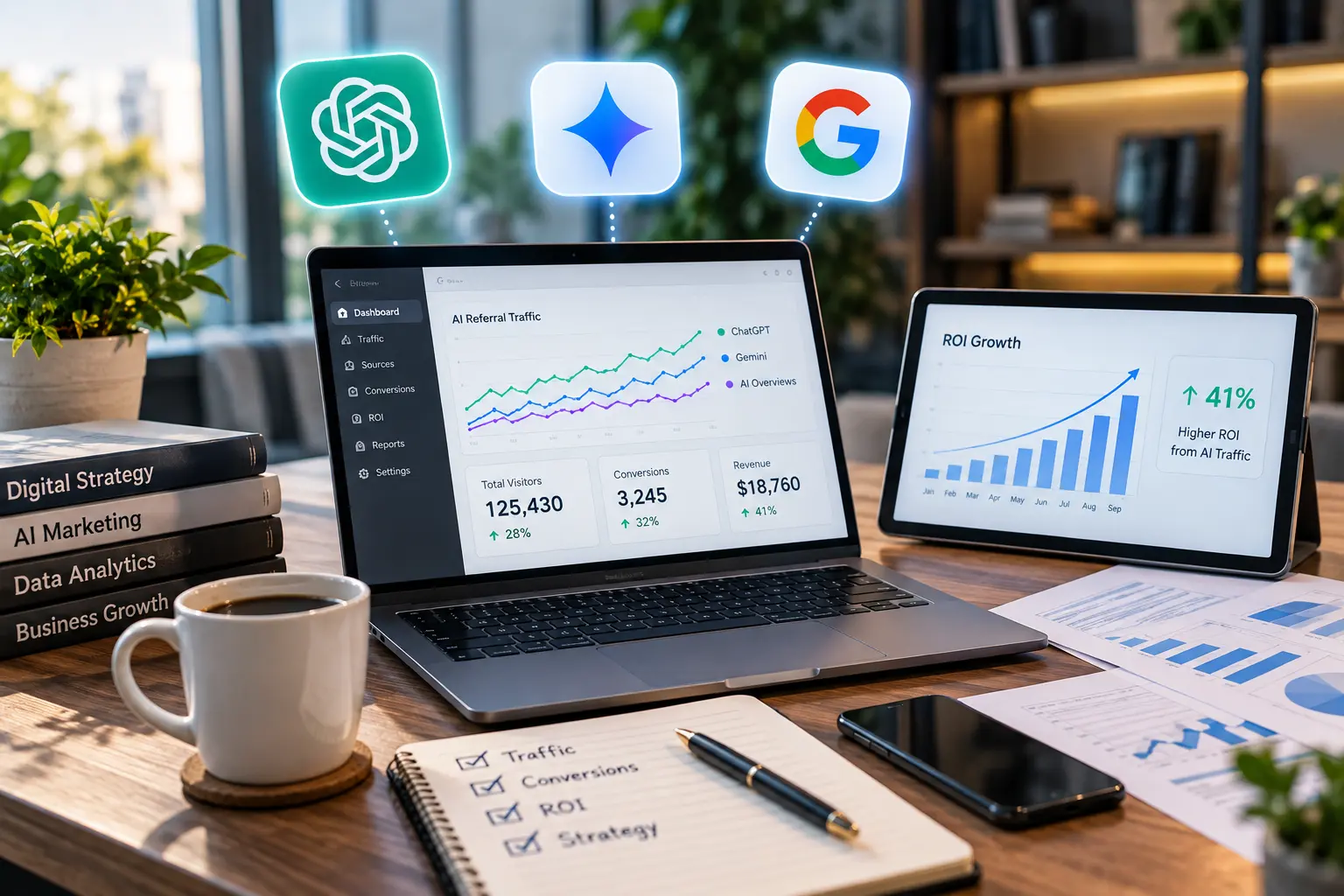
If Google’s AI can’t lift a clear answer from your page in a few seconds, it will lift one from a competitor’s instead. That’s the reality of search in 2026. AI Overviews now sit above the traditional blue links for a meaningful share of queries, and they pull their answers from pages that make information easy to extract, not just pages that rank well.
Google AI Overviews optimization isn’t a separate discipline bolted onto SEO — it’s what SEO looks like when the reader is sometimes an algorithm summarizing your page instead of a person scrolling through it. This guide breaks down exactly how AI Overviews choose sources, and what you can change on your pages to get pulled into them.
What Are Google AI Overviews, and Why Should You Care?
Google AI Overviews are the AI-generated summary boxes that appear at the top of search results for many informational and comparison queries. Instead of showing ten blue links and letting the user pick one, Google synthesizes an answer from a handful of pages and presents it directly on the results page — often before a single click happens.
That shift changes the economics of ranking. A page can hold a strong position and still lose clicks if the AI Overview already answered the question. On the flip side, getting cited inside that summary puts your brand in front of the searcher even when they don’t click through, and it tends to drive higher-intent traffic when they do.
This is where AI search optimization and Google AI Overviews SEO diverge from older tactics. Ranking well is still the entry ticket. But being chosen as a source for the AI-generated answer depends on a different set of signals: clarity, structure, and how easily your content can be verified and reused.
How Google Decides What Goes Into an AI Overview
Google’s AI systems aren’t looking for the longest page or the most keyword mentions. They’re looking for content that reduces the work needed to answer a question confidently. In practice, that means AI Overviews tend to favor pages that:
- State the answer plainly near the top, without making the reader dig for it
- Use headers that mirror how people actually search or ask questions
- Break down comparisons, steps, and data into scannable formats
- Come from sources that appear current, accurate, and well-maintained
- Carry structured data that clarifies what the content is about
If your page buries the answer under three paragraphs of preamble, an AI system has to do extra interpretation to extract it — and it will often choose a competitor’s page that made the job easier instead.
Core Strategies for Google AI Overviews Optimization
1. Lead With a Direct, Self-Contained Answer
Under every major heading, answer the question in the first two or three sentences before adding context. Think of it as writing a summary that could be lifted and used on its own, in about 40–60 words. This single change does more for AI Search Results visibility than almost anything else on this list, because it matches exactly how AI Overviews extract information.
2. Write Headers as Questions
Convert your H2s and H3s into the actual phrasing people use when they search — “How do AI Overviews choose sources?” performs differently than a vague label like “Ranking Factors.” Question-based headers line up directly with the queries that trigger AI Overviews in the first place, which improves your odds of being matched and cited.
3. Structure Comparisons and Steps Visually
Tables, numbered steps, and bullet lists are easier for AI systems to parse and reuse than dense paragraphs. If you’re comparing two options, features, or costs, a short table will consistently outperform a paragraph describing the same information for both AI Overviews SEO and readability.
4. Build Topical Authority With Content Clusters
A single well-written page rarely earns consistent AI citations on its own. Google’s systems weigh how thoroughly a site covers a topic. Build a pillar page around your core subject, then support it with linked articles that cover related questions in depth. That internal linking structure helps AI systems understand how your content connects and signals real depth rather than a one-off post.
5. Add Structured Data (Schema Markup)
Schema doesn’t guarantee inclusion in an AI Overview, but it removes ambiguity about what your content is — an FAQ, a how-to, a product, a review. Article, FAQ, and HowTo schema in particular give AI systems a cleaner path to understanding your page’s structure and intent.
6. Strengthen E-E-A-T Signals
Content with a visible, credentialed author, cited sources, and transparent sourcing is more likely to be trusted as a citation. Add real author bios, link to credible references where relevant, and avoid vague, unattributed claims. Trust signals matter more, not less, in an AI-mediated search environment.
7. Keep Content Fresh
AI systems weigh recency heavily, especially for topics that shift often. A page last substantively updated two or three years ago competes poorly against one refreshed with current data, examples, or figures. Revisit evergreen pages every few months, update anything outdated, and reflect that update visibly on the page.
8. Fix the Technical Basics
None of the above matters if Google can’t crawl and render your page quickly. Confirm there are no indexing issues, avoid content that only loads via JavaScript, and keep load times low. Slow, hard-to-crawl pages are simply less likely to be trusted as sources, regardless of how well the content itself is written.
AEO, GEO, and Traditional SEO: How They Fit Together
You’ll increasingly see three terms used alongside AI search optimization:
- SEO gets your page discovered and ranked in the first place.
- AEO (Answer Engine Optimization) structures your content to directly answer specific questions, which is what earns AI Overview citations.
- GEO (Generative Engine Optimization) extends that same thinking to AI platforms beyond Google — tools like ChatGPT, Perplexity, and Copilot — which pull from similar signals: clear structure, credible sourcing, and unique, verifiable information.
These aren’t competing strategies. A page built well for AEO and GEO is, almost by definition, also a stronger traditional SEO page — clear structure and genuine authority help across every surface where your content might show up.
Common Mistakes That Keep Content Out of AI Overviews
- Answering the question too late in the page, after unnecessary introductions
- Writing headers as vague labels instead of the actual questions people ask
- Relying entirely on long paragraphs with no lists, tables, or scannable structure
- Publishing thin content with no unique data, examples, or expert insight
- Letting evergreen pages go stale without updates for years at a time
Tracking Your AI Overview Performance
Google Search Console now includes AI Mode and AI Overview data alongside standard search performance — appearances count as impressions, and clicks on any links within the response count as clicks. Start by identifying pages with high impressions but declining click-through rates; those are often the ones being displaced by an AI Overview, and they’re the best candidates for restructuring using the strategies above. It’s also worth manually checking your priority queries in Google periodically to see whether an AI Overview appears and which sources it’s citing.
Final Thoughts
Google AI Overviews aren’t going away, and the businesses that adapt early are the ones capturing visibility while competitors are still writing for 2020-era search. The core idea is simple even if the execution takes work: make your content the easiest, most trustworthy answer on the page for both a human reader and an AI system to find.
If you want your website built around content that performs across traditional rankings, AI Overviews, and AI search platforms alike, our team at Sandstream can help you put that strategy together — reach out and let’s map out where your content stands today.