
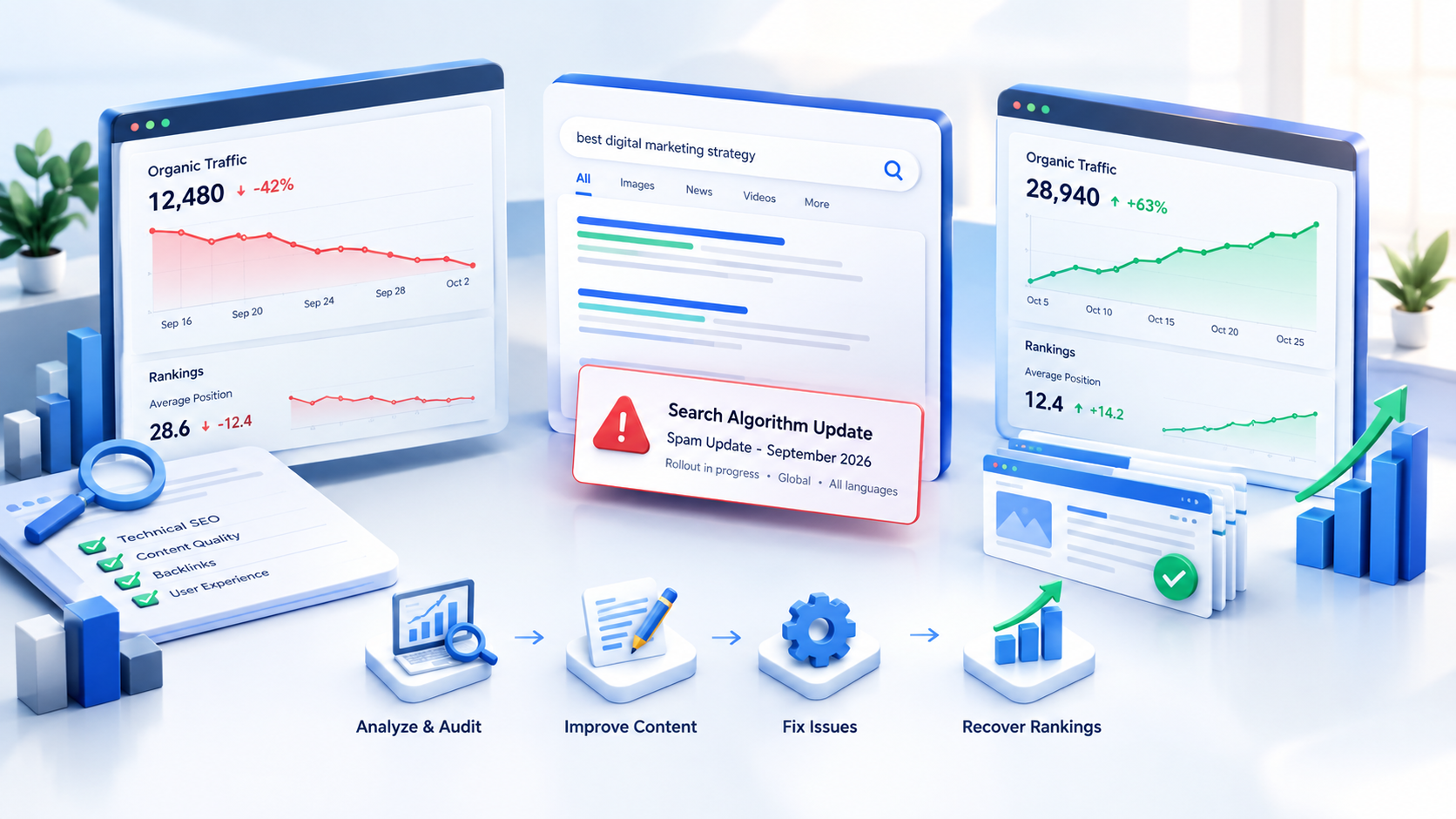
Google Search updates can create sudden changes in organic rankings, traffic, and visibility. When a website loses positions shortly after an update, one of the first questions is whether the update caused the decline.
The Google September 2026 spam update began on September 24, 2026, at 9:15 a.m. PDT. Google says the update applies globally and across all languages, with the rollout potentially taking up to two weeks. The Google Search Status Dashboard currently lists the update as active and identifies ranking as the affected product.
That means website owners should be careful about making major SEO changes based on short-term ranking movements while the rollout is still underway.
If your rankings dropped after the update, the right response is not to panic or immediately rewrite your entire website. Instead, investigate the pages and queries affected, review Google’s spam policies, check your technical and content signals, fix genuine problems, and continue monitoring performance.
What Is the Google September 2026 Spam Update?
The Google September 2026 spam update is a Google Search ranking update focused on spam-related systems.
Google officially announced the rollout on September 24, 2026. The update is global and applies to all languages. Google also stated that the rollout may take up to two weeks to complete.
Unlike a routine website change, a Google spam update can affect how search systems identify and evaluate websites or pages that may violate Google’s spam policies.
However, Google has not publicly stated that the September update targets one specific spam tactic. Therefore, website owners should avoid assuming that a ranking decline was caused by AI content, links, expired domains, or another individual tactic without evidence.
Instead, analyze the actual changes in your website’s Search performance.
Why Does Google Release Spam Updates?
Google’s spam systems are designed to protect Search results from practices intended to manipulate rankings instead of providing useful information to searchers.
Google’s spam policies cover several forms of abuse, including scaled content abuse, scraping, misleading functionality, link spam, cloaking, and other practices that attempt to manipulate Search rankings.
The overall goal is to prevent search results from being dominated by pages that offer little value or use manipulative techniques to gain visibility.
For website owners, this means SEO should focus on creating useful content, maintaining trustworthy site practices, ensuring important pages are accessible to search engines, and avoiding tactics designed primarily to manipulate rankings.
Why Did My Google Rankings Drop After the Spam Update?
A Google ranking drop after a spam update does not automatically mean your website received a manual penalty or violated a specific spam policy.
Several things can happen during a broad Search update.
Your rankings may change because:
- Google reassesses spam-related signals.
- Competing pages may move up or down.
- Search results may change for particular queries.
- Some pages may lose visibility while others remain stable.
- A website may have content or practices that need improvement.
- Ranking fluctuations may occur while the update is still rolling out.
Because the September 2026 spam update is still active, it is particularly important to distinguish temporary volatility from a sustained decline.
Before changing your strategy, compare your performance before and after the update and identify exactly which pages, queries, countries, devices, and search appearances changed.
How to Check If Your Website Was Affected
Start with Google Search Console.
Look at your Performance report and compare a meaningful period before the update with the period after September 24.
Review:
1. Clicks
Check whether organic clicks decreased significantly.
2. Impressions
A drop in impressions can indicate that your pages are appearing less frequently for relevant searches.
3. Average position
Look for pages or queries that experienced substantial ranking changes.
4. Queries
Identify the search terms associated with the largest declines.
5. Pages
Determine whether the decline affects the entire website or only specific URLs.
6. Countries and devices
Check whether the change is concentrated in a particular market or device type.
This analysis can help distinguish a site-wide pattern from a problem affecting a smaller group of pages.
Also remember that Google Search Console data can fluctuate naturally. A few days of movement should not automatically be treated as evidence of a spam-related issue.
What Should You Do After a Google Spam Update?
If your organic visibility has decreased, follow a structured process instead of making random SEO changes.
Step 1: Confirm the Timing
First, compare your traffic and rankings with the update timeline.
The September 2026 spam update started on September 24 and can take up to two weeks to complete.
If your rankings changed before September 24, the spam update cannot automatically explain that earlier decline.
Similarly, if rankings fluctuate during the rollout, wait for additional data before making large-scale decisions.
Step 2: Identify the Pages That Lost Visibility
Do not immediately edit every page.
Create a list of URLs that experienced the largest declines.
For each page, examine:
- Primary search intent
- Content quality
- Originality
- Search relevance
- Internal links
- External references
- User experience
- Page accessibility
- Search performance history
This helps you focus resources where the evidence indicates a problem.
Step 3: Review Your Content for Real User Value
One of the most important questions is:
Does this page provide something useful that a searcher cannot easily get from dozens of other pages?
Look for content that is:
- Thin
- Repetitive
- Generic
- Automatically generated without meaningful editing
- Heavily rewritten from other sources
- Created primarily to capture search traffic
- Missing original examples or useful information
- Overloaded with keywords
- Written around keywords instead of user needs
Google’s spam policies specifically describe scaled content abuse as generating many pages primarily to manipulate Search rankings rather than help users. The policy applies regardless of whether the content was created manually, automatically, or through generative AI.
That distinction is important.
AI-generated content is not automatically spam. The problem is content created at scale without adding sufficient value for users.
Step 4: Remove or Improve Low-Value Pages
If you identify pages that provide little or no value, determine whether they should be:
- Improved substantially
- Consolidated with another useful page
- Redirected where appropriate
- Removed from Search when they serve no useful purpose
Do not delete pages simply because they experienced a ranking decline.
A ranking drop alone does not prove that a page is low quality.
Evaluate the page based on its purpose, usefulness, search intent, and overall quality.
Step 5: Check for Scaled Content Problems
If your website has recently published a large number of pages, review them carefully.
Ask:
- Were many pages created from the same template?
- Do multiple pages repeat nearly identical information?
- Are location pages substantially different or simply keyword substitutions?
- Were AI tools used to produce large quantities of content without meaningful editorial review?
- Does each page offer unique value?
- Are pages targeting slightly different keywords but answering essentially the same question?
Google’s spam documentation specifically identifies large-scale production of low-value pages as scaled content abuse. Examples include generating many pages with generative AI without adding user value, scraping or transforming existing content, and creating keyword-focused pages that provide little useful information.
Step 6: Review Third-Party Content
If your website publishes content from external contributors, affiliates, partners, or other third parties, review those sections separately.
Google’s site reputation abuse policy addresses situations where third-party content is published primarily to take advantage of the ranking signals of an established host website.
This does not mean every guest article or third-party contribution is problematic.
The important question is whether the content exists because it genuinely benefits the site’s audience or primarily because the host site’s existing reputation can help that content rank.
Step 7: Review Your Link Practices
Check whether your website has acquired links through practices that violate Google’s spam policies.
Look for:
- Unnatural link-building patterns
- Paid links intended to manipulate rankings
- Excessive link exchanges
- Automated link creation
- Low-quality directories
- Links placed primarily for ranking manipulation
Do not remove legitimate links simply because they exist.
Focus on identifying genuinely manipulative patterns.
Step 8: Improve Internal Linking
Internal links help users and search engines discover related content.
Review whether important pages receive relevant internal links from authoritative pages on your website.
Use descriptive anchor text that explains what the linked page is about.
For example, instead of repeatedly using generic anchors such as “click here,” use meaningful phrases that accurately describe the destination.
A strong internal-link structure can also help organize topical relationships between your service pages, supporting articles, guides, and other useful resources.
Step 9: Improve Content With First-Hand Value
One of the strongest ways to strengthen a page is to add information that demonstrates genuine experience and expertise.
Depending on the topic, that could include:
- Original examples
- Data
- Screenshots
- Case studies
- Expert commentary
- Practical processes
- Industry-specific observations
- Comparisons
- Original visuals
- Lessons learned from real projects
Instead of simply rewriting information that already exists online, make the page more useful.
For example, an article about recovering from a Google update could provide a practical Search Console investigation workflow rather than simply repeating Google’s announcement.

How Can You Recover From a Google Spam Update?
Google spam update recovery is not a single technical fix.
There is no universal button that restores rankings after an algorithmic change.
The recovery process generally involves identifying the underlying issue, correcting it, improving affected content or site practices, and allowing Google to recrawl and reassess the website.
A practical recovery workflow looks like this:
Diagnose → Identify affected pages → Review spam policies → Fix genuine issues → Improve content → Strengthen site quality → Monitor → Reassess
Diagnose
Find out what actually changed.
Identify
Determine whether the decline affects particular pages, topics, templates, or site sections.
Review
Compare the affected content and practices against Google’s current spam policies.
Fix
Correct problems that are actually present.
Improve
Add useful information, originality, expertise, and better user experience.
Monitor
Continue tracking Search Console performance after changes.
Reassess
Look for sustained improvement rather than judging success based on a single day’s ranking movement.
This approach is more reliable than making dozens of unrelated SEO changes at once.
How Long Does Google Spam Update Recovery Take?
There is no universal recovery timeframe.
The September 2026 update itself may take up to two weeks to complete.
After making improvements, Google needs to crawl, process, and reassess the affected content. The timeframe can vary depending on the website, the changes made, crawling patterns, and the nature of the issue.
This is why website owners should avoid expecting rankings to return immediately after publishing an update or changing a few pages.
Focus on making measurable improvements and monitoring the trend over time.
What Should You Avoid Doing After a Ranking Drop?
A ranking decline can create pressure to make immediate changes, but some reactions can make diagnosis more difficult.
Avoid:
Rewriting the entire website at once
You may remove content that was actually performing well.
Changing URLs unnecessarily
URL changes can introduce additional technical complications.
Adding keywords everywhere
Keyword stuffing does not solve underlying quality problems.
Publishing hundreds of new pages
More content is not automatically better. If the new pages provide little value, publishing more of them can create additional quality concerns.
Buying backlinks to recover rankings
Manipulative links can create additional problems rather than solving the original issue.
Removing every page that lost rankings
A ranking decline does not prove that a page violates Google’s spam policies.
Making changes before collecting data
Without a baseline, it becomes difficult to determine which changes actually affected performance.
Does AI Content Cause Google Rankings to Drop?
Not automatically.
Google’s spam policies focus on the purpose and value of content rather than simply whether AI was involved in its creation.
Google specifically identifies the use of generative AI to create many pages without adding value for users as one example of scaled content abuse.
That means businesses using AI as part of their content workflow should focus on editorial quality.
AI can assist with research, organization, brainstorming, editing, and other workflows, but the final content should provide genuine value and should not simply generate large volumes of similar pages designed primarily to capture search traffic.
How to Protect Your Website From Future Spam Updates
The best long-term approach is to build a website that provides clear value independent of individual algorithm updates.
Create content for people first
Start with the problem the user is trying to solve.
Build topical depth
Create useful supporting content around important subjects rather than publishing disconnected keyword variations.
Maintain editorial standards
Review AI-assisted and human-created content before publication.
Avoid scaled low-value publishing
Do not create pages simply because a keyword exists.
Keep tracking consistent
Use Search Console and analytics to monitor organic visibility and conversions.
Review Google’s spam policies
Google’s spam documentation should be part of a regular SEO quality review, especially when your publishing strategy changes.
Keep improving existing content
Refreshing valuable content can be more useful than continuously producing new pages.
Google September 2026 Spam Update: A Practical Recovery Checklist
If your website experienced a ranking decline, use this checklist:
- Confirm when the ranking decline started
- Compare Search Console data before and after September 24
- Identify affected pages and queries
- Check whether the decline is site-wide or limited to specific sections
- Review affected content for originality and user value
- Check for scaled low-value content
- Review AI-generated pages for meaningful editorial value
- Review third-party content
- Check for manipulative link practices
- Improve weak or repetitive pages
- Strengthen relevant internal linking
- Improve useful content rather than adding keyword repetitions
- Monitor performance throughout and after the rollout
- Avoid making unnecessary large-scale changes
This approach gives you a structured way to respond without assuming that every ranking fluctuation is caused by the spam update.
Final Takeaway
The Google September 2026 spam update is currently an active global ranking update, and Google says the rollout can take up to two weeks.
If your website experienced a ranking decline, the first step is diagnosis—not panic.
Look at when the decline started, which pages and queries changed, and whether there are genuine content or site-practice issues that need attention. Review Google’s spam policies, particularly if your website uses large-scale content production, third-party content, or other SEO tactics that could create quality or manipulation concerns.
Most importantly, do not assume that AI content itself is the reason for a ranking decline. Google’s scaled-content policy focuses on producing large amounts of content primarily to manipulate rankings rather than provide value, regardless of how that content was created.
The goal of Google spam update recovery should therefore be more than regaining a lost position. It should be about creating a website with useful, original, trustworthy content and sound SEO practices that can continue serving users as Google Search evolves.