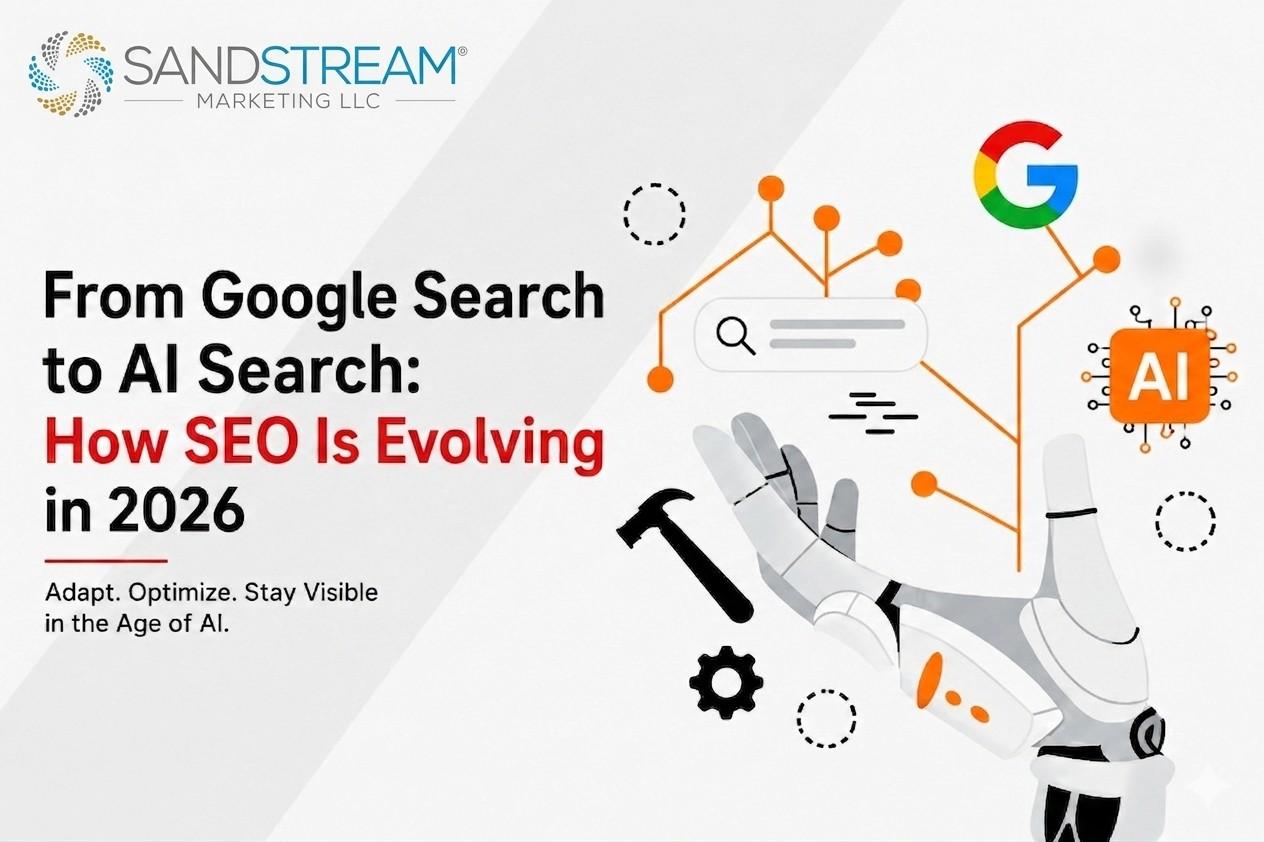
Generative Engine Optimization (GEO) is the practice of structuring your website content so that AI-powered search platforms – including ChatGPT, Google AI Overviews, Perplexity, and Microsoft Copilot – cite, reference, and recommend your brand in their generated answers.
If you have noticed that search results now often display a full AI-written summary before any blue links appear, you have already seen GEO in action. In 2026, this is no longer a niche experiment. Google AI Overviews now reach over 2 billion monthly users, ChatGPT serves 800 million users each week, and Gartner projects that traditional organic search volume will drop 25% this year as users shift to AI-powered answer engines.
That shift has one clear implication for businesses: ranking on Page 1 is not enough anymore. The brands that win in 2026 are the ones being cited inside the AI answer – before users ever scroll to the link list.
This guide from SandStream Marketing breaks down exactly what GEO is, how it differs from traditional SEO, and the step-by-step strategies proven to get your brand cited across every major AI search platform.
Quick Answer – What Is Generative Engine Optimization?
Generative Engine Optimization (GEO) is the process of optimizing digital content to be discovered, cited, and recommended by AI search engines like ChatGPT, Google AI Overviews, Perplexity, and Microsoft Copilot.
Unlike SEO, which targets a ranked list of blue links, GEO targets the AI-generated summary that now appears above all traditional results – the answer the user reads first and trusts most.
Research from Princeton University confirms that targeted GEO techniques can boost content visibility in AI-generated responses by 30–40%.
GEO vs SEO: Understanding the Critical Difference in 2026
Many marketers ask whether GEO replaces SEO. The short answer: no. But the two disciplines have fundamentally different goals, success metrics, and ranking factors. Understanding both is essential for any brand that wants full-spectrum digital visibility in 2026.
SEO gets you clicked. GEO gets you quoted.
Traditional search engines return a list of links. Generative AI engines synthesize information from multiple sources into a single conversational response. A page can rank number one in Google yet never appear in a ChatGPT or Perplexity answer if it lacks the structural and factual signals that AI retrieval systems prioritize.
GEO vs SEO: Side-by-Side Comparison
| Factor | Traditional SEO | GEO (AI Search) |
|---|---|---|
| Primary Goal | Rank in search results (blue links) | Get cited in AI-generated answers |
| Success Metric | Organic rankings & traffic | AI mention rate & citation frequency |
| Key Signal | Backlinks & keyword density | Factual density & structured data |
| Content Style | Persuasive, SEO-formatted | Neutral, densely factual, well-structured |
| Ranking Decay | Months to years | ~13 weeks without content refresh |
| Platforms | Google, Bing SERPs | ChatGPT, Gemini, Perplexity, Google AI Overviews |
| Schema Importance | Helpful for rich snippets | Critical for AI extraction & citation |
The most important practical implication: AI engines typically cite only 2 to 7 domains per response, compared to Google’s 10 blue links. The competition for AI citation slots is intense — but early movers gain compounding advantages as AI systems reinforce trusted sources across related prompts.
Why AI Search Optimization in 2026 Cannot Be Ignored
The numbers tell the story clearly:
- ChatGPT has over 800 million weekly active users – more than the population of Europe.
- Google AI Overviews appear in an estimated 15–25% of all searches, skewing heavily toward informational, how-to, and comparison queries – exactly the searches where buyers are making decisions.
- AI-referred sessions jumped 527% year-over-year in the first five months of 2025.
- Research from GEO firm Brandlight shows the overlap between top Google organic links and AI-cited sources has dropped from 70% to below 20% – meaning your SEO rankings no longer predict your AI visibility.
- Fewer than 12% of marketing teams have a documented GEO strategy, creating a major early-mover advantage for businesses that act now.
When your brand is cited inside an AI Overview or a ChatGPT answer, users see your name with an implicit endorsement from the AI – a trust signal no paid ad or organic listing can replicate. And critically, even users who never click through will associate your brand with authoritative knowledge on that topic.
How AI Search Engines Actually Select Content to Cite
To optimize for GEO, you need to understand how AI retrieval actually works. Most major AI search engines use a process called Retrieval-Augmented Generation (RAG):
- The AI breaks your query into multiple sub-queries (called query fan-out) and searches for each independently.
- It retrieves the most relevant pages from its index, with structured data and clear entity signals carrying the highest weight.
- It passes the retrieved content to a large language model (LLM), which synthesizes a single answer and selects which sources to cite.
- Sources are cited based on factual density, structural clarity, authority signals, and content freshness — not keyword frequency.
This is why traditional SEO tactics like keyword stuffing actively hurt GEO performance. The Princeton GEO research (Aggarwal et al., 2024) confirmed that keyword stuffing performed poorly in generative contexts, while statistics addition, citing external sources, and clear structural formatting showed the strongest visibility improvements.
Proven GEO Strategies: How to Rank in AI Search Results
Lead With a Clear Definition (Definition-Lead Architecture)
AI retrieval systems weigh the first 150–200 tokens of a page heavily during the summarization step. Pages whose opening sentence contains a clear definitional structure — [Entity] is a [category] that [differentiator] – receive significantly higher impression scores in LLM-based retrieval pipelines.
Every major section of your content should follow the same pattern: open with a direct, self-contained answer to the likely user query, then support it with detail. AI systems often extract individual sections from longer articles, so every block must stand alone as a complete answer.
Add Statistics and Cite Authoritative Sources
The single highest-impact GEO technique identified in Princeton’s research is adding verifiable statistics and citing authoritative external sources. This can boost AI visibility by up to 40%. Practical implementation:
- Include 3–5 citations per article from authoritative sources (academic studies, government data, well-known industry reports).
- Place citations inline at the claim location, not just in a references section at the bottom.
- Use specific data points with exact numbers – “AI-referred sessions jumped 527%” outperforms “AI referrals increased significantly.”
- Always link to the original source, not an aggregator page.
Structure Content for AI Extraction
AI engines rely on structure to identify and extract information reliably. The formatting choices that most improve AI citation rates in 2026:
- Use question-based H2 and H3 headings that mirror how users actually phrase queries (“How does GEO differ from SEO?”).
- Open each section with a 50–70 word direct answer before expanding with supporting detail – this is the format Google’s AI pulls for Overviews.
- Use numbered lists for processes and bullet points for attributes or comparisons.
- Keep paragraphs to 3–4 sentences maximum for readability and extraction accuracy.
- Create dedicated FAQ sections that mirror real user search queries – FAQ schema is one of the most-cited elements in Google AI Overviews.
Implement Schema Markup (Critical for AI Citation)
Schema markup has evolved from a nice-to-have SEO enhancement into a critical requirement for AI visibility. Google’s Helpful Content guidance now explicitly states that structured data helps Google’s AI understand your content – shifting schema’s role from traditional SERP optimization to a direct citation-extraction signal.
Content with proper schema markup has a 2.5x higher chance of appearing in AI-generated answers. Sites with complete schema coverage see up to 40% more Google AI Overview appearances. Priority schema types for 2026:
- Article schema – establishes authorship and content type, reinforcing E-E-A-T signals.
- FAQPage schema – AI engines parse FAQ schema to extract concise answers directly; keep answers between 40–60 words for optimal extraction.
- HowTo schema – structures step-by-step instructions for reliable AI processing; keep each step to 1–2 sentences.
- Organization schema – every website needs this as a foundation for entity recognition.
- Speakable schema – marks specific paragraphs as suitable for AI narration and voice extraction, increasingly important as AI audio overviews grow.
Always implement schema using JSON-LD (not Microdata or RDFa). JSON-LD lives in a dedicated script block, giving AI crawlers a clean, unambiguous signal layer separate from your HTML content.
Create an llms.txt File
The emerging llms.txt standard is a text file placed in your website root directory (e.g., https://yoursite.com/llms.txt) that provides AI crawlers with a structured markdown summary of your site’s most important pages and content – similar to what robots.txt does for traditional search bots, but specifically designed for large language models.
Adding an llms.txt file helps AI systems understand your site’s content hierarchy, identify your most authoritative pages, and index your content more accurately. WordPress users can generate this automatically with plugins like All in One SEO.
Unblock AI Crawlers
Before any content optimization can work, AI systems need to be able to read your pages. This is the most commonly overlooked GEO issue. Check the following:
- Verify your robots.txt is not blocking GPTBot (ChatGPT), ClaudeBot (Anthropic), PerplexityBot, or Google-Extended (Google AI).
- If you use Cloudflare, check your settings — Cloudflare recently changed its default configuration to block AI bots, which may have cut off your AI crawler traffic automatically.
- Ensure important content is server-side rendered, not hidden behind JavaScript, paywalls, or interactive elements that AI bots cannot access.
- Check your server logs for AI crawler user-agents to confirm they are visiting your site.
Build Topical Authority With Content Clusters
AI engines strongly prefer websites that consistently publish content around a focused subject area. A single blog post is rarely enough to establish the topical authority required for repeated AI citation. Build a content cluster strategy:
- Publish a comprehensive pillar page on your main topic (like this GEO guide).
- Create 5–10 related supporting articles that link back to the pillar (e.g., “How to Write FAQs for Google AI Overviews,” “Schema Markup Guide for AI Search,” “GEO Metrics to Track in 2026”).
- Interlink all cluster pages to signal to both traditional search engines and AI systems that your domain has deep expertise on the subject.
- Publish original research, proprietary data, or unique frameworks – when you produce something no other source has, AI engines have a strong reason to cite you.
Refresh Content on a Regular Cadence
AI citation decay is real: content not updated at least quarterly is three times more likely to lose its AI citations. AI engines weigh recency when selecting sources, and a guide from 2024 with no updates will lose ground to a 2026 article on the same topic.
Best practices for content freshness:
- Add a visible “Last Updated” timestamp and update it every time you make meaningful changes.
- Implement dateModified in your Article schema and ensure it reflects real editing activity.
- Add a “What Changed in 2026” or “2026 Update” section to cornerstone content – AI tools actively look for these signals.
- Aim for at least quarterly reviews of your most important pages, with monthly updates for fast-moving topics.
Google AI Overviews Optimization: What Works in 2026
Google AI Overviews now appear in 15–25% of all searches and can command up to 75.7% of mobile screen real estate when combined with featured snippets. Being cited in an AI Overview provides brand visibility to millions of users – even those who never click your link.
The content formats most frequently cited in Google AI Overviews:
- Comprehensive how-to guides with clear numbered steps.
- Definition and explanation articles that directly answer “what is” questions.
- Comparison articles structured as X vs Y with organized comparison sections.
- Listicle-style content with well-organized H2 and H3 subheadings.
- Expert opinion pieces from authors with demonstrated credentials and clear author bios.
- Content from domains with strong backlink profiles and high topical authority.
There is also strong evidence that content ranking in featured snippets is more likely to be pulled into AI Overviews. Traditional SEO remains the entry ticket to the retrieval phase of the AI pipeline – you generally need to rank in the top 10 to be eligible for AI Overview consideration, making SEO and GEO genuinely complementary disciplines.
E-E-A-T: The Trust Foundation of GEO
Experience, Expertise, Authoritativeness, and Trustworthiness (E-E-A-T) remain among the most critical signals for AI-driven search visibility. AI systems actively try to identify content that is accurate, reliable, and genuinely produced by someone with subject-matter credibility.
How to strengthen E-E-A-T for GEO:
- Add detailed author bios with credentials, LinkedIn profiles, and relevant experience.
- Include links to reputable external sources (academic studies, government data, respected industry publications).
- Publish consistently under named authors rather than a generic company byline.
- Earn mentions and citations from respected third-party domains – AI engines are more likely to cite sources that other authoritative sources reference.
- Avoid vague, unverifiable claims and aggressive promotional language – AI systems actively discount content that reads as marketing copy rather than information.
How to Measure GEO Performance
Traditional SEO metrics – organic rankings, click-through rate, impressions – do not capture AI engine visibility. GEO requires its own measurement framework. The three core KPIs to track:
- Mention Rate: The percentage of AI-generated answers that mention your brand name when queried on your target topics.
- Citation Rate: The percentage of AI-generated answers that include a clickable URL linking to your domain.
- Citation Position: Where your brand appears in the AI answer – first mention carries significantly more authority and visibility than being buried at the end.
To measure these, define 15–25 target prompts that represent your core keyword clusters. Test each prompt manually across ChatGPT, Perplexity, Google AI Overviews, and Copilot on a regular cadence. Dedicated GEO monitoring platforms can automate this process across eight or more AI engines simultaneously.
Google Search Console now also provides some data on AI Overview appearances – track impressions, clicks, and CTR for your optimized pages.
Common GEO Mistakes That Reduce AI Visibility
Most websites struggle with AI visibility because their content was built for traditional search engines rather than AI retrieval systems. The most common mistakes:
- Blocking AI crawlers in robots.txt without realizing it – especially after Cloudflare configuration changes.
- Keyword stuffing – the single fastest way to disqualify content from AI citation; AI systems prefer neutral, densely factual prose over repetitive keyword placement.
- Long paragraphs with no structure – AI extraction accuracy drops significantly when content lacks headings, bullets, and organized sections.
- Overly promotional writing – AI engines discount content that prioritizes marketing messaging over informational accuracy.
- Thin content with no original data or expert perspective – without something unique, AI engines have no reason to cite you over dozens of similar sources.
- Ignoring content freshness – pages not updated for 6+ months steadily lose citation priority as newer articles on the same topic emerge.
- Missing schema markup – without JSON-LD schema, AI engines must infer content structure through natural language processing, which introduces errors and reduces citation accuracy.
2026 GEO Action Checklist for SandStream Marketing Clients
Technical Foundation
- Verify AI crawlers are not blocked in robots.txt (GPTBot, ClaudeBot, PerplexityBot, Google-Extended)
- Check Cloudflare settings — confirm AI bots are not being blocked at the CDN level
- Add or audit llms.txt file in your root directory
- Ensure key content is server-side rendered and accessible without login
- Implement JSON-LD schema: Article, FAQPage, HowTo, Organization
- Add dateModified to Article schema and maintain an honest update schedule
Content Optimization
- Open every key section with a clear, self-contained 50–70 word answer
- Use question-based H2 and H3 headings that mirror real user search queries
- Add verifiable statistics with inline citations to authoritative external sources
- Include a dedicated FAQ section targeting high-volume questions in your niche
- Eliminate keyword stuffing – write for factual density, not keyword density
- Add author bios with credentials to every key piece of content
Authority & Freshness
- Build a content cluster: pillar page + 5–10 interlinked supporting articles
- Add a ‘Last Updated’ date and ‘2026 Update’ section to cornerstone content
- Refresh top-performing pages at least quarterly
- Publish original research, proprietary data, or unique frameworks
- Monitor AI citation rates across ChatGPT, Perplexity, Gemini, and Google AI Overviews monthly
Final Thoughts: GEO Is the New Baseline for Digital Visibility
Search is changing faster than most marketing strategies can keep up with. Generative Engine Optimization is no longer an experimental add-on to your SEO program – it is the new baseline for brands that want to remain visible as AI search reshapes how people discover, evaluate, and choose businesses online.
The gap between brands investing in GEO now and those waiting is widening every month. AI systems reinforce trusted sources across related prompts – early movers build compounding authority that late optimizations struggle to displace.
At SandStream Marketing, we help businesses build content strategies that win in both traditional search and AI-generated discovery. From technical GEO audits and schema implementation to content cluster strategy and AI citation monitoring, we deliver the full-stack approach that modern search demands.
Ready to get your brand cited in AI search results? Contact SandStream Marketing today for a GEO audit of your website.