
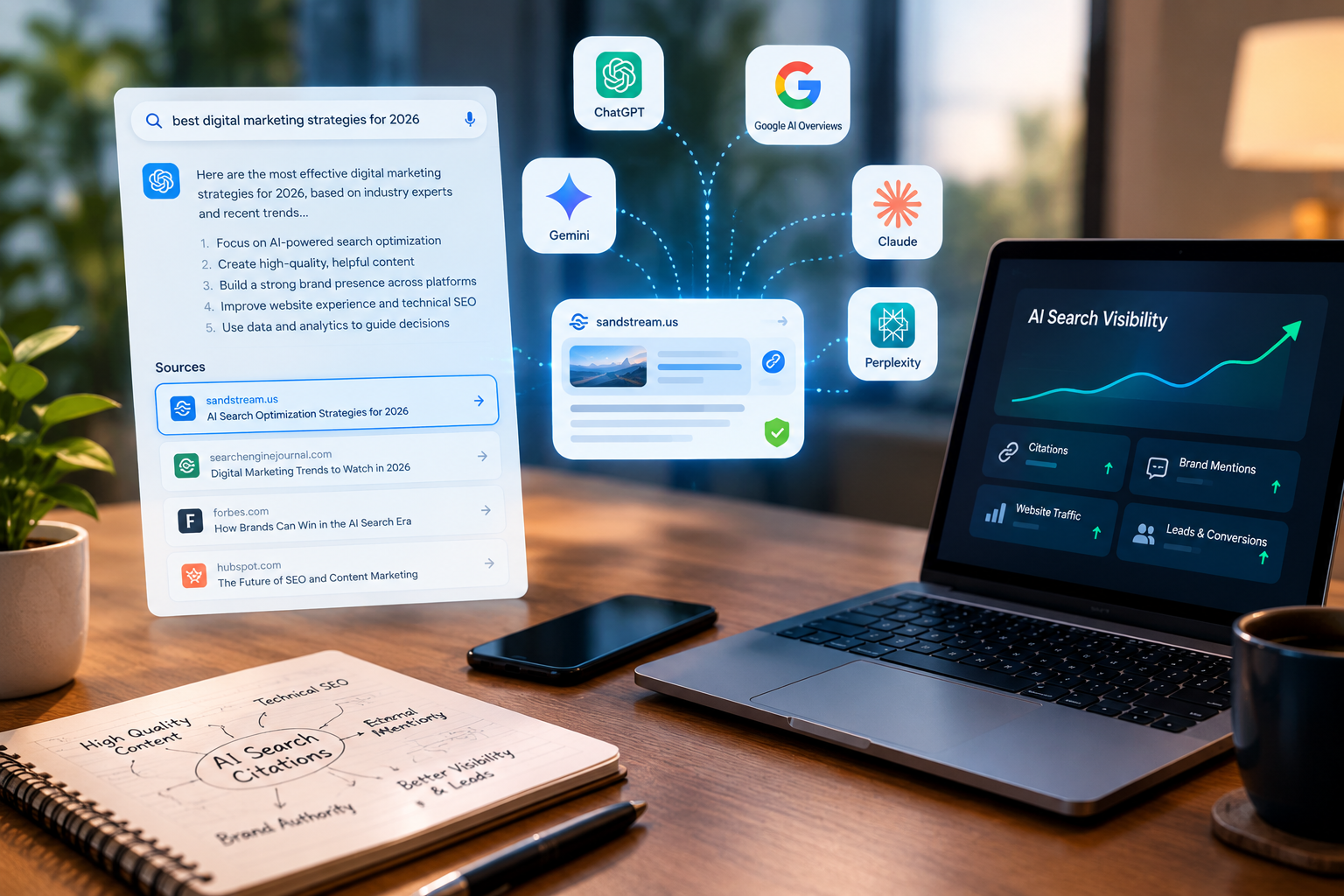
AI search is changing how people discover businesses, compare services, and decide which brands to trust. Instead of displaying only a list of website links, platforms such as ChatGPT, Google AI Overviews, Gemini, and Perplexity can summarize information and cite selected sources in their answers.
For businesses, this creates a new opportunity: AI search citations can help your website become a source of information when potential customers research your industry, evaluate solutions, or look for recommendations.
However, publishing more content is not enough. Your website needs useful answers, accurate information, clear brand positioning, and credible signals that help search systems understand why your content deserves to be referenced.
This guide explains how to optimize your website for AI search citations in 2026, improve AI search visibility, and turn relevant discovery into meaningful website traffic and business leads.
What Are AI Search Citations?
AI search citations are links to web pages, research, or other sources that an AI-powered search experience references to support its answer.
For example, someone might ask an AI assistant, “What are the best ways for a small business to improve its online visibility?”
The assistant could summarize several recommendations and link to articles explaining SEO, content marketing, or digital marketing strategies. If your website provides relevant, reliable information, one of your pages may be selected as a citation.
AI citations and brand mentions are different. A brand mention occurs when an AI answer names your business, while a citation provides a link to a source. Your brand can be mentioned without receiving a citation, and your content can be cited without your company being named in the answer.
Both matter, but citations offer an additional opportunity for people to visit your website and explore your services.
Why AI Search Citations Matter for Businesses in 2026
People increasingly use AI-powered tools to research complex questions, compare products, evaluate service providers, and find solutions to specific problems. These platforms can influence which sources users see during their decision-making process.
For businesses, getting cited can support several marketing goals.
1. Increase qualified website traffic
A citation can give readers a direct path to your website. When your page answers a question that matches their needs, visitors may be more interested in your services than people browsing unrelated content.
2. Build brand credibility
Being referenced as a source can help demonstrate that your content provides useful information. The impact depends on the context of the citation, the platform, and the user’s needs.
3. Reach customers earlier in their buying journey
A potential customer might ask an AI assistant how to solve a problem before searching for an agency or service provider. Helpful content can introduce your brand while that person is still researching options.
4. Support traditional SEO performance
AI search optimization does not replace SEO. Search engines and AI-powered experiences still need to discover and interpret relevant information. Technical accessibility, useful content, internal links, and relevant authority signals remain important foundations.
5. Create additional opportunities for leads
When an AI citation brings someone to a service page, case study, or practical guide, a clear next step can turn that visit into an inquiry. Citations alone do not guarantee conversions, so your website experience and offer still matter.
How to Optimize Your Brand for AI Search Citations
Improving your chances of getting cited requires a coordinated approach to content, technical SEO, brand credibility, and performance measurement. The following AI search optimization strategies provide a practical starting point.
1. Create Content That Directly Answers Real Questions
AI-powered search experiences often respond to complete questions rather than isolated keywords. Your content should therefore address the problems customers actually want to solve.
Start by identifying the questions your audience asks before choosing a product or service.
For a digital marketing agency, relevant questions might include:
- How can a small business improve its visibility in AI search?
- What is the difference between traditional SEO and AI search optimization?
- How can businesses measure brand visibility in ChatGPT?
- Which website improvements help search engines understand a business?
- How can companies attract qualified leads through organic search?
Create dedicated sections or pages for questions that deserve a detailed answer. Avoid creating multiple thin pages that repeat essentially the same information.
Practical tip: Put a direct answer near the beginning of each section. Follow it with the reasoning, examples, steps, or evidence that make the answer useful.
For example, instead of beginning with a long introduction about the history of search, explain what AI search citations are and how businesses can work toward earning them.
This structure helps readers understand your content quickly and makes the page easier for search systems to interpret.
2. Match Search Intent Instead of Repeating Keywords
Using your target keyword naturally is important, but keyword repetition alone will not make a page citation-worthy.
Consider the keyword “AI search citations.” Someone searching for it may want to understand what citations are, learn how to earn them, or find professional help improving their AI visibility.
A strong article can address these related needs without forcing the exact keyword into every paragraph.
Use the primary keyword in appropriate locations, such as the title, introduction, a relevant heading, and the conclusion. Include related phrases where they genuinely fit the topic.
These may include:
- Getting cited by AI search
- AI citation optimization
- AI search visibility
- AI search optimization strategies
- AI brand visibility
The goal is to build a complete explanation of the subject rather than produce a page that reads like a list of search terms.
3. Structure Content So It Is Easy to Understand and Reference
Clear formatting improves the reading experience and helps search systems identify important information.
Organize your articles using descriptive headings, short paragraphs, logical sections, and lists when they make complex information easier to follow.
A useful structure for an AI-focused article might include:
- A direct introduction to the problem
- A concise definition of the main concept
- A section explaining why the topic matters
- Step-by-step recommendations
- Practical examples or original research
- Common mistakes to avoid
- Frequently asked questions
- A relevant next step for the reader
Make headings descriptive enough to communicate what each section covers. For example, “How to Improve AI Search Visibility” is more informative than a vague heading such as “Getting Better Results.”
You can also use short summary paragraphs for complex topics. However, do not reduce every section to a generic two-sentence answer. Readers need enough detail to understand the recommendation and apply it.
4. Publish Original Insights, Data, and Examples
AI search systems can find many pages explaining the same basic concepts. Content that adds something useful beyond existing explanations gives readers a stronger reason to reference it.
Instead of publishing another generic article about SEO, show what you have learned through actual work.
Consider including:
- Original research based on a clearly explained methodology
- Case studies showing the starting point, actions, and outcomes
- Before-and-after examples of website improvements
- Expert commentary supported by relevant evidence
- Practical checklists created from real projects
- Data visualizations with clear sources and explanations
- Detailed comparisons that help readers make decisions
For example, a digital marketing agency could publish an analysis of how a website appears across a defined set of AI search queries before and after content improvements. The article should explain the testing period, platforms checked, queries used, and limitations.
Do not invent performance figures or claim that a change caused an improvement unless the evidence supports that conclusion.
Original information makes your content more useful to readers and gives other websites a potential reason to reference it.
5. Strengthen Your Website’s Technical SEO
Useful content cannot perform as expected if search systems struggle to access or interpret it.
Technical SEO provides the foundation for discoverability. Review the following areas as part of your AI citation optimization process.
Crawlability and indexability: Check that important pages are accessible to search crawlers and are not unintentionally blocked by robots.txt, noindex directives, authentication, or other technical issues.
XML sitemap: Maintain an accurate sitemap containing the important canonical URLs you want search engines to discover.
Internal linking: Link related articles to relevant service pages and other useful resources. Use descriptive anchor text so readers and search systems can understand the relationship between pages.
Page performance: Improve unnecessary delays, intrusive layouts, and usability problems. A fast, accessible website supports a better experience, although page speed alone does not guarantee AI citations.
Canonical URLs: Use consistent canonical signals to reduce confusion when similar content is accessible through multiple URLs.
Structured data: Implement relevant, valid Schema.org markup where appropriate. For example, Article, Organization, and BreadcrumbList markup may help clarify the page type, business identity, and site structure. Structured data does not guarantee inclusion in AI answers.
Search crawler access: Review the current access requirements of the search and AI platforms relevant to your business. Do not block the crawlers needed for discovery or retrieval if you want those platforms to access your content.
Technical requirements differ between platforms. A page being indexed by Google does not guarantee that every AI assistant will retrieve or cite it.
6. Build a Clear and Consistent Brand Identity
AI brand visibility depends partly on whether systems can connect your business name with the products, services, expertise, and information associated with it.
Make your business identity easy to understand across your digital presence.
Start with your website’s About page. Explain who you are, what you do, whom you help, and what makes your approach useful.
Your service pages should clearly describe the problem each service addresses, the process involved, and the outcomes customers can reasonably expect.
Also review your business name, contact information, company descriptions, and service details across relevant public profiles and directories. Correct inconsistencies rather than creating more listings solely to increase the number of mentions.
If you operate in a specific location, keep your local business information accurate and maintain an up-to-date Google Business Profile where applicable.
The objective is to build a consistent, verifiable picture of your business—not to repeat your company name everywhere.
7. Earn Relevant Mentions and Citations From Third-Party Websites
Your own website is only one part of your online presence. Industry publications, reputable directories, professional communities, customer reviews, and other relevant websites can provide additional context about your business.
These sources may influence how customers discover and evaluate your brand, and some may be referenced in AI-generated answers.
Focus on earning relevant coverage through legitimate activities, such as:
- Contributing expert commentary to industry publications
- Publishing research that journalists or industry writers can reference
- Participating in relevant professional discussions
- Building genuine partnerships with complementary businesses
- Encouraging honest customer reviews
- Maintaining accurate profiles on trusted industry directories
- Creating useful resources that other websites naturally want to link to
Choose sources based on relevance, credibility, audience, and editorial quality—not just a third-party domain authority score.
Avoid buying bulk mentions, publishing spam comments, or creating fake reviews. These practices can damage trust and do not provide a reliable path to AI search citations.
The aim is to establish a credible presence wherever your potential customers look for information.
8. Make Service Pages Useful Beyond Promotional Copy
Many business websites describe their services without explaining how those services solve customer problems. That can leave visitors with unanswered questions.
Improve your service pages by providing clear, specific information.
For example, a digital marketing service page could explain:
- Which business problems the service addresses
- What the process includes
- What information or access is required from the client
- Which deliverables the client receives
- How progress is measured
- What factors influence cost and timelines
- Which types of businesses are a good fit
Use real examples where possible, and distinguish between typical deliverables and outcomes that depend on the client’s market or starting position.
Connect educational blog posts to the most relevant service pages through contextual internal links. Someone reading about AI search optimization should be able to find the related service or contact page without having to navigate the entire website.
This approach supports both SEO and lead generation by connecting informational searches with relevant commercial next steps.
9. Optimize for Google AI Overviews and Other AI Platforms
Not all AI search platforms work in the same way. Some experiences retrieve current web pages and display citations, while others may rely on different retrieval processes or existing model knowledge.
Therefore, avoid assuming that one optimization technique will produce identical results everywhere.
For Google AI Overviews, maintain strong SEO fundamentals, publish helpful and original content, and make sure your important pages are accessible and eligible for search.
For ChatGPT and Perplexity, test relevant questions in experiences that provide web search or source links. Review whether your pages are discovered and cited for the questions your customers ask.
For Gemini and Claude, assess visibility using the search-enabled features available to you and review the sources displayed in the responses.
Across platforms, focus on a few shared principles:
- Publish content that genuinely answers relevant questions.
- Keep facts, service descriptions, and business details accurate.
- Make pages easy to crawl, navigate, and understand.
- Support important claims with evidence or reputable sources.
- Build a credible presence on relevant external websites.
- Review platform-specific documentation as access and retrieval features change.
You cannot guarantee that a platform will select your page. The goal is to improve the quality, relevance, and accessibility of your content while measuring the results.
10. Measure AI Search Visibility and Citation Performance
An AI optimization strategy needs a measurement process. Otherwise, you may publish more content without knowing whether it is improving your brand’s visibility.
Start by creating a list of questions potential customers might ask when researching your industry.
Include informational questions, comparisons, service-related questions, and location-specific queries where relevant.
Test these questions across the AI platforms your audience uses. Record whether your brand appears, whether your website is cited, which URLs are referenced, and which competing brands or third-party sources appear.
Repeat the checks under reasonably consistent conditions. AI responses can change based on the platform, date, location, wording, and other context.
Track these indicators:
AI citation frequency: How often your website appears as a linked source across your chosen set of prompts and tests.
Brand mention frequency: How often your business is named in relevant AI responses, including answers that do not link to your website.
Citation coverage: Which pages, topics, and customer questions generate citations—and which important areas remain uncovered.
Organic search performance: Monitor relevant search impressions, clicks, rankings, and landing pages through Google Search Console.
Referral traffic: Use analytics tools to identify visits from AI platforms when referral information is available. Some AI-influenced visits may not be identifiable as such.
Lead quality and conversions: Measure form submissions, calls, consultation requests, and other meaningful business outcomes. Where possible, connect these conversions with the landing page and referral source.
Avoid treating a single AI response as proof of success or failure. Use repeated observations to identify patterns and decide what to improve next.
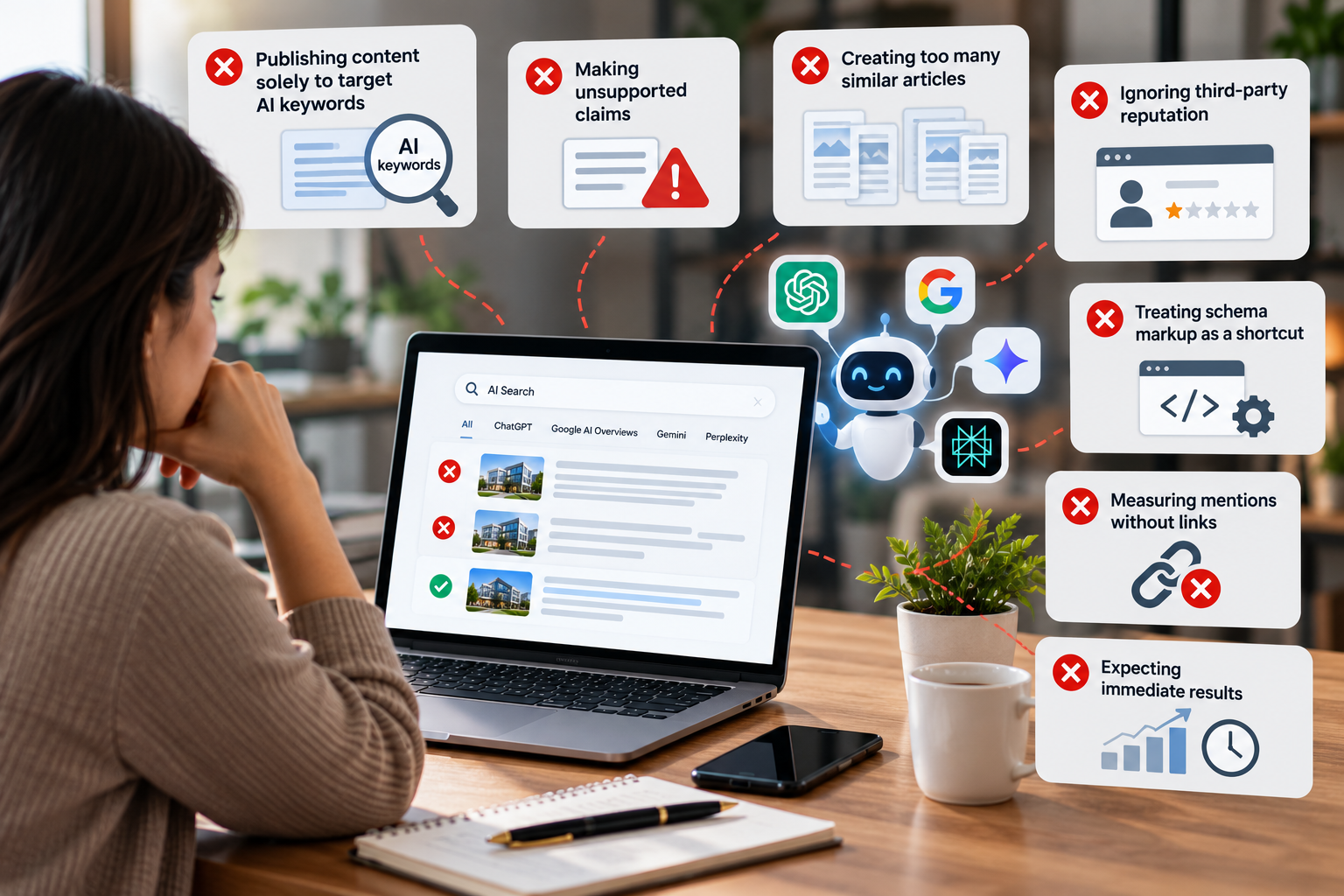
Common Mistakes That Reduce Your Chances of Getting AI Search Citations
Even a well-designed content strategy can underperform when it relies on shortcuts instead of useful information.
Avoid these common mistakes.
Publishing content solely to target AI keywords: Articles that repeat terms without answering meaningful questions offer little value. Build content around real user needs.
Making unsupported claims: Statistics, expert statements, and business claims should be accurate and verifiable. Cite reliable sources when using external evidence.
Creating too many similar articles: Multiple pages targeting almost identical questions can dilute your content strategy. Consolidate overlapping material when appropriate.
Ignoring third-party reputation: A polished website does not automatically establish a strong reputation. Build genuine relationships and maintain accurate business information across relevant sources.
Treating schema markup as a shortcut: Structured data can clarify information, but adding schema does not force an AI platform to cite a page.
Measuring mentions without links: Brand mentions and citations are different indicators. Track them separately to understand whether your business is named, linked, or both.
Expecting immediate results: Discovery, indexing, content updates, and AI retrieval can take time. Review performance regularly and adjust your strategy based on evidence.
A Practical 30-Day Plan for AI Citation Optimization
You do not need to overhaul your entire website at once. Start with a focused plan that prioritizes important pages and measurable improvements.
Week 1: Audit Your Current Visibility
- List the questions your ideal customers ask before buying.
- Test a representative set of questions across relevant AI platforms.
- Record existing brand mentions, citations, and competing sources.
- Review your website’s indexability, internal links, and important landing pages.
Goal: Establish a baseline and identify the biggest visibility gaps.
Week 2: Improve High-Priority Content
- Update existing articles that already attract relevant search impressions.
- Answer the main question earlier in each article.
- Add specific examples, accurate evidence, and useful explanations.
- Improve headings and remove repetitive or outdated sections.
- Link each relevant article to an appropriate service page.
Goal: Make your most valuable pages more useful, complete, and accessible.
Week 3: Strengthen Brand Authority
- Review your About page and core service descriptions.
- Correct important business information across relevant profiles.
- Identify publications, professional communities, and partners relevant to your audience.
- Develop one original resource or insight that others may find useful.
Goal: Improve the consistency and credibility of your online presence.
Week 4: Measure and Refine
- Repeat your AI visibility tests using the same questions.
- Compare citations and mentions with the original baseline.
- Review changes in organic impressions, clicks, referral traffic, and leads.
- Identify pages that need better answers or additional evidence.
- Prioritize the next improvements based on business value.
Goal: Turn AI search optimization into an ongoing process instead of a one-time project.
This plan is a starting framework, not a promise of citation growth within 30 days. Results depend on your website, competition, content quality, and how individual platforms retrieve information.
How AI Search Citations Can Support Lead Generation
Visibility is valuable, but the business outcome matters too.
Imagine a potential customer asking an AI assistant how to improve organic traffic and appear in AI-generated answers. The assistant cites a detailed guide from your website.
That visitor reads your advice, explores a relevant service page, reviews your expertise, and decides whether to contact your team.
This journey works best when the content and the next step match the visitor’s intent.
To improve the chances of converting relevant visitors:
- Connect informational articles to appropriate service pages.
- Explain your process and deliverables clearly.
- Include relevant case studies or examples when available.
- Make contact forms easy to complete.
- Offer a useful consultation or next step without making unrealistic promises.
- Measure qualified inquiries instead of focusing only on page views.
For SandStream, this means connecting educational content about search visibility and digital marketing with relevant marketing solutions. The connection should help readers understand how professional support could address their specific business challenges.
Final Thoughts
Optimizing for AI search citations in 2026 requires more than adding AI-related keywords to existing pages. Businesses need content that answers real questions, technical foundations that support discovery, a clear brand identity, and credible information across the web.
Begin with your most important customer questions. Improve the pages that address them, strengthen relevant internal and external connections, and track whether your brand appears in the AI search experiences your audience uses.
Most importantly, connect visibility with business outcomes. The objective is not simply to appear in more AI answers; it is to help the right people discover your expertise, trust your business, and take the next step.
If your business needs a clearer strategy for content, search visibility, and digital marketing, explore SandStream’s marketing solutions to see how a tailored approach can support your growth goals.