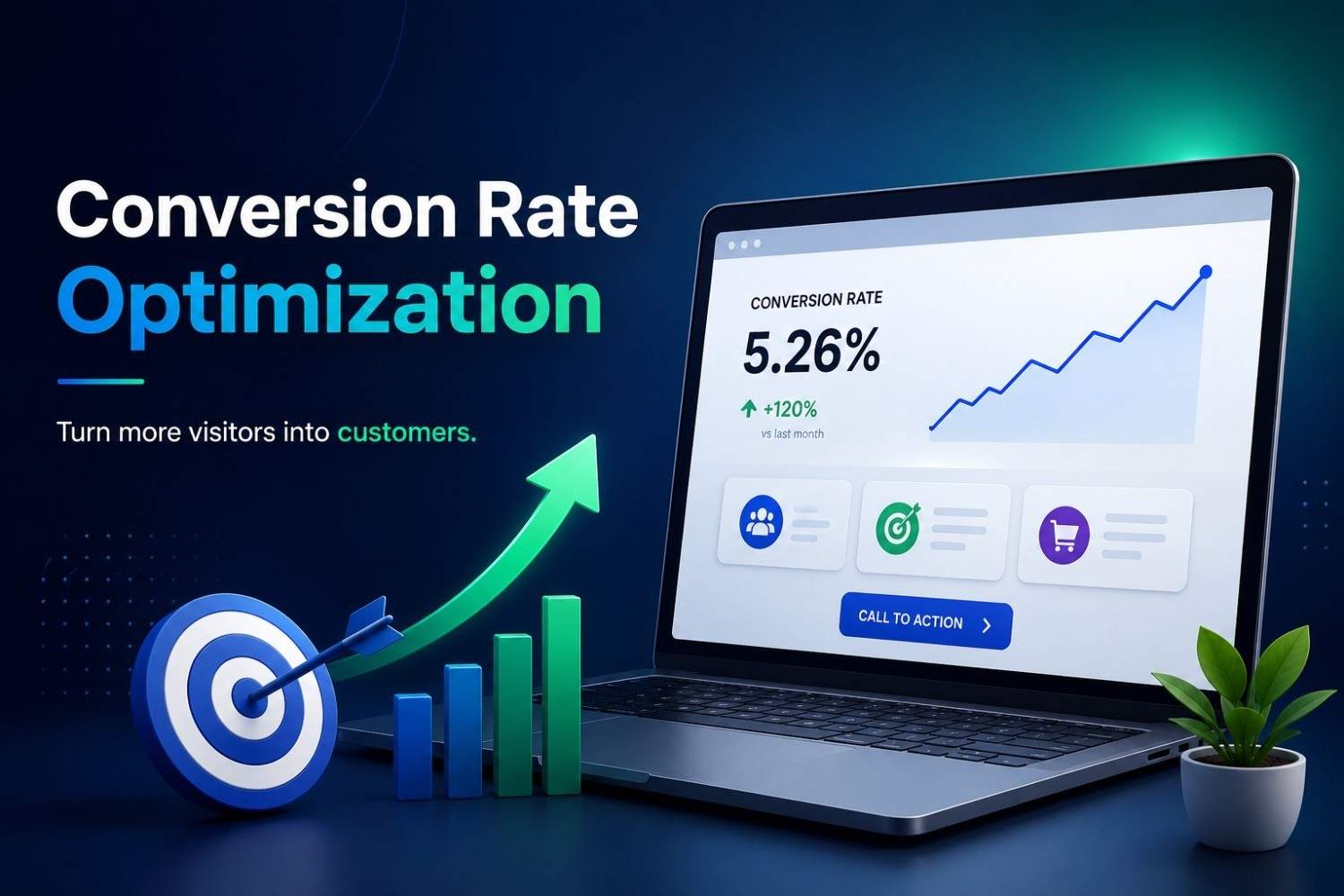
Most websites get traffic, but not all of it turns into results. Visitors often land on a page, scroll for a few seconds, and leave without taking any action. This gap between visits and conversions is where many businesses lose potential opportunities.
Conversion rate optimization focuses on improving this gap. Instead of only bringing more traffic, it helps you make better use of the visitors you already have by improving how they interact with your website.
A strong website conversion optimization approach looks at user behavior, identifies friction points, and improves key elements so more visitors complete desired actions. In this guide, we’ll look at practical ways to improve website conversions and how small changes in design, content, and structure can lead to better results over time.
What is Conversion Rate Optimization?
Conversion rate optimization is the process of improving your website so a higher percentage of visitors complete a desired action.
A conversion can include:
- Filling out a contact form
- Signing up for emails
- Booking a call
- Making a purchase
- Downloading a resource
For example, if 1,000 people visit your website and 30 take action, your conversion rate is 3%.
The main goal of CRO is to understand user behavior and reduce anything that stops users from converting.
Why CRO Matters for Your Business
Many businesses focus heavily on traffic generation through SEO, ads, and social media. But without CRO, that traffic is wasted potential.
Here’s why CRO is important:
- Higher ROI from existing traffic
- Lower customer acquisition costs
- More leads and sales without increasing ad spend
- Better user experience
- Stronger business growth with the same audience
A strong CRO strategy for websites ensures every visitor has a higher chance of becoming a customer.
How to Improve Website Conversions
Improving conversions is not about guesswork. It comes from understanding how users interact with your website and making thoughtful improvements based on that behavior, which is the core of conversion rate optimization.
Below are some of the most effective and practical ways to improve website performance and increase conversions through better website conversion optimization.
1. Improve Website Speed and Performance
A fast website is essential for conversion rate optimization. Slow-loading pages can cause visitors to leave before taking action, affecting your website conversion optimization efforts. Keep pages loading within 2–3 seconds by optimizing images, reducing scripts, and using reliable hosting.
2. Create Clear and Compelling Headlines
Your headline is often the first thing visitors notice. Instead of generic messaging, focus on clear value that explains what your page offers. A strong headline improves website conversion optimization by helping users quickly understand your content and encouraging them to stay.
3. Use Strong Call-to-Actions (CTAs)
CTAs are a key part of conversion rate optimization because they guide users toward the next step. In website conversion optimization, your CTAs should be clear, visible, and action-focused. Simple phrases like “Get Started Today” or “Book Your Consultation” make it easier for visitors to take action.
4. Simplify Your Forms
Long or complicated forms can reduce conversions. Keep forms short and ask only for essential information to create a smoother experience. The easier your forms are to complete, the more likely users are to convert.
5. Build Trust with Social Proof
Trust is an important part of turning visitors into customers. Adding testimonials, reviews, case studies, or client logos helps build credibility and gives users more confidence to take the next step.
Landing Page CRO Tips
Landing pages play an important role in conversions. Small improvements can make a noticeable difference.
- Focus on One Goal: A landing page should have a single, clear purpose rather than multiple actions.
- Keep the Layout Clean: Simple layouts help users focus on the main message without distractions.
- Match the Message: The landing page should match what users expected when they clicked an ad or link.
- Make CTAs Easy to See: Users should not have to search for the next step. CTAs should be visible and clear.
- Reduce Distractions: Avoid unnecessary links or elements that take attention away from the main action.
A Simple CRO Strategy for Websites
A basic CRO strategy for websites can be built in a few simple steps.
- Step 1: Understand User Behavior: Use analytics tools or heatmaps to see how users interact with your site.
- Step 2: Identify Drop-Off Points: Find pages or sections where users leave the website.
- Step 3: Make Small Improvements: Focus on one change at a time, such as improving a headline or CTA.
- Step 4: Test Changes: Compare different versions to see what works better.
- Step 5: Continue Improving: CRO is an ongoing process rather than a one-time task.
Common Mistakes to Avoid
Some small issues can have a big impact on conversions, even if they are often overlooked.
- Overcomplicated or cluttered design that confuses users
- Unclear messaging that makes it hard to understand the offer
- Slow page speed that causes visitors to leave early
- Too many form fields that reduce completion rates
- Weak or poorly placed CTAs that users don’t notice
These may seem like simple problems, but they often directly affect how well a website converts visitors into actions.
Start Improving Your Website Conversions Today
Conversion rate optimization is not about redesigning everything. It is about understanding how users interact with your website and improving their experience step by step. Small improvements in clarity, speed, and structure can gradually increase conversions. When your website conversion optimization focuses on reducing friction and making actions easier, results usually improve without needing additional traffic.
Want to improve your website conversions? Contact us today to get started.